Skip to content







Luxury packaging has always balanced two competing priorities: premium presentation and operational efficiency. Traditional rigid setup boxes deliver an upscale unboxing experience, but they also consume significant warehouse space, increase freight costs, and limit pallet utilization. As shipping rates continue to fluctuate and fulfillment operations become more complex, procurement teams are looking for packaging that maintains brand perception without creating unnecessary logistics expenses.
Rigid collapsible boxes have become a practical solution for many retail, e-commerce, and subscription brands. They offer the same premium appearance customers expect while reducing storage volume before assembly. In my experience managing high-volume custom production runs, brands rarely switch to collapsible construction because of aesthetics alone. The decision is usually driven by measurable savings in warehousing, transportation, and inventory management without sacrificing structural performance or print quality.

Quick Answer
Why are rigid collapsible boxes replacing traditional rigid packaging?
Rigid collapsible boxes are replacing traditional rigid packaging because they provide the same premium appearance while significantly improving storage efficiency and reducing freight costs. Their fold-flat design allows businesses to maximize warehouse space, lower shipping expenses, and streamline inventory management without sacrificing structural strength or luxury presentation. For wholesale buyers, this often results in a lower total cost of ownership across the supply chain.
In This Guide
In this article, you’ll learn:
- What makes rigid collapsible boxes different from traditional rigid setup boxes
- Why brands are moving toward fold-flat premium packaging
- How collapsible construction improves shipping and warehouse efficiency
- The structural materials behind high-quality rigid collapsible packaging
- Wholesale considerations for U.S. businesses sourcing custom packaging
- Expert manufacturing insights before placing a bulk order
What Makes a Rigid Collapsible Box Different?
At first glance, a rigid collapsible box looks almost identical to a conventional rigid setup box. Both are designed to deliver a premium customer experience and are commonly used for cosmetics, electronics, luxury apparel, jewelry, subscription products, and corporate gifts. The difference becomes obvious before the product is even packed.
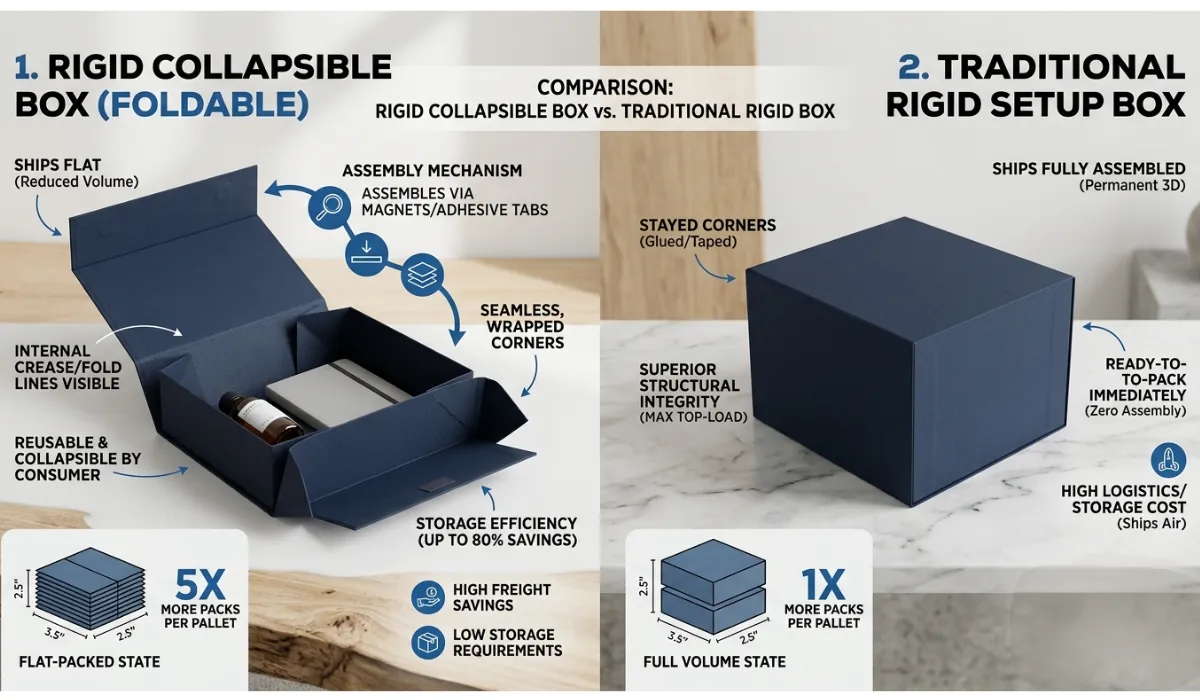
A traditional rigid box is permanently assembled at the factory. Every unit occupies its full three-dimensional volume throughout transportation, storage, and distribution. That design works well for presentation but becomes expensive as order quantities increase.
A rigid collapsible box is engineered with precision folding panels, reinforced corner joints, and an integrated magnetic closure or locking mechanism that allows the box to ship flat. Once it reaches the packing facility, it can be assembled within seconds while maintaining the clean appearance expected from luxury packaging.
This structural approach provides measurable operational advantages for businesses shipping thousands of units every month.
Key characteristics include:
- Fold-flat storage before use
- Rigid greyboard construction for premium strength
- Magnetic closure options
- Custom interior inserts for product protection
- Luxury print finishes without compromising structural integrity
- Reduced warehouse footprint compared to setup boxes

From a manufacturing standpoint, achieving consistent fold performance requires accurate die-line engineering and tight production tolerances. Even slight deviations during board converting or wrapping can affect how the panels align after assembly. That level of precision is one reason experienced packaging manufacturers invest heavily in quality control during production.
Businesses looking for fully customized Rigid Collapsible Boxes can choose different board thicknesses, closures, inserts, and premium finishing options depending on their product requirements.
Why More Brands Are Moving Away From Traditional Setup Boxes
Many buyers initially compare packaging based on unit price alone. That approach overlooks several operational costs that become significant over time.
What procurement managers often miscalculate during sourcing is the total cost of ownership rather than the manufacturing cost of the box itself.
A traditional rigid box may seem competitively priced until additional warehouse storage, freight charges, pallet utilization, and inventory handling are factored into the equation.
Rigid collapsible boxes address many of these hidden expenses.
Reduced Warehouse Storage
Because collapsible boxes ship flat, businesses can store substantially more units within the same warehouse footprint. This becomes especially valuable for seasonal product launches and companies managing multiple SKUs.
Higher storage density can also reduce warehouse leasing costs and improve inventory organization.

Lower Freight Costs
Freight carriers calculate shipping expenses using both weight and dimensional volume. Traditional setup boxes consume far more cubic space during transportation.
Fold-flat packaging allows significantly more units per pallet, improving trailer utilization and reducing transportation costs across regional and nationwide distribution networks. Understanding how packaging dimensions influence logistics can help businesses reduce shipping expenses over time.
For companies shipping nationwide throughout the United States, these savings often become more noticeable than the difference in manufacturing price.
Faster Inventory Management
Warehouse teams spend less time organizing oversized packaging inventory when products arrive flat-packed. Inventory counts become simpler, storage racks remain less congested, and replenishment cycles are easier to manage.
In fulfillment environments processing thousands of daily orders, even small improvements in storage efficiency can contribute to smoother operations and lower labor costs.
Technical Materials & Structural Engineering Behind Rigid Collapsible Boxes
A rigid collapsible box is only as reliable as the materials and engineering behind it. Premium appearance means little if the box begins to lose shape after repeated handling or arrives at the customer with crushed corners. Structural performance starts long before printing it begins with board selection, die-line accuracy, and manufacturing precision.
In my experience overseeing luxury packaging projects, the biggest quality differences between suppliers are rarely visible in product photos. They become obvious during assembly, pallet stacking, and long-distance freight.
Greyboard Thickness Matters
Most rigid collapsible boxes are manufactured using greyboard because of its density and compression strength. The board thickness should match the product weight rather than following a one-size-fits-all specification.

Typical applications include:
| Greyboard Thickness | Recommended Use |
|---|---|
| 1.5 mm | Lightweight cosmetics, invitation kits, promotional products |
| 2.0 mm | Apparel, beauty products, subscription boxes |
| 2.5 mm | Premium electronics, gift sets, luxury retail packaging |
| 3.0 mm | Heavy products requiring maximum structural support |
Choosing the right board specification is only one part of engineering premium Custom Rigid Boxes, as structural design and finishing techniques also influence durability and presentation.
Wrapping Materials and Surface Finishes
The outer wrap determines how customers perceive your brand before they even open the package.

Common wrapping options include:
- Premium coated art paper
- Uncoated textured paper
- Kraft paper for natural branding
- Specialty papers with linen or fabric textures
- Soft-touch laminated paper
- Anti-scratch laminated paper
If your brand prioritizes responsible sourcing, choosing paper certified by the Forest Stewardship Council (FSC) helps demonstrate that the paper materials originate from responsibly managed forests.
These materials can be enhanced with premium finishing techniques such as:
- Foil stamping
- Spot UV coating
- Embossing
- Debossing
- Matte lamination
- Gloss lamination
The key is selecting finishes that complement the product category rather than applying every decorative option available. Over-engineered packaging often increases production costs without improving customer perception.
These decorative finishes are widely used across Luxury Rigid Boxes for cosmetics, electronics, jewelry, and premium retail packaging.
Magnetic Closure Performance
Magnetic closures are one of the defining features of many rigid collapsible boxes.
However, their performance depends on accurate placement during production.
If magnets are even slightly misaligned, buyers may experience:
- Uneven closing pressure
- Lid shifting
- Weak closure strength
- Visible panel gaps
- Faster wear over repeated use
Manufacturers producing high-volume orders should verify magnetic alignment during quality inspections rather than relying solely on visual checks. Businesses that prioritize a premium unboxing experience often prefer Magnetic Closure Boxes because they combine secure product protection with an elegant presentation.
Domestic Wholesale Advantages for U.S. Businesses
For businesses sourcing custom packaging in the United States, supplier selection extends beyond unit pricing. Lead times, communication, freight planning, and production consistency often have a greater impact on long-term profitability.
What procurement managers frequently discover after switching suppliers is that production delays can cost significantly more than a small difference in box pricing.
Faster Turnaround Times
Domestic wholesale suppliers generally provide:
- Faster artwork approvals
- Shorter sampling cycles
- Reduced shipping transit times
- Easier production updates
- Better coordination for repeat orders
This flexibility becomes particularly valuable during seasonal promotions, retail launches, and limited-edition product releases where timing directly affects revenue.
Better Quality Control
Quality issues become easier to resolve when production teams operate within similar business hours and communicate efficiently.
Reliable manufacturers inspect:
- Board thickness consistency
- Print registration
- Color accuracy
- Corner alignment
- Adhesive bonding
- Magnetic closure positioning
- Surface finish quality
Consistent quality checks reduce rejected shipments and minimize costly production delays.
Understanding MOQ Reality
Many businesses focus exclusively on finding the lowest Minimum Order Quantity (MOQ).
In reality, extremely low MOQs often increase the cost per unit because tooling, setup, printing, and finishing expenses are distributed across fewer boxes.
For established brands, slightly larger production runs usually deliver:
- Better unit pricing
- Improved production efficiency
- Lower repeat setup costs
- More consistent color matching across batches
Finding the right balance between inventory capacity and production volume generally produces better long-term purchasing decisions than selecting the smallest possible order.
Companies planning larger production runs should also understand how wholesale pricing models affect long-term packaging budgets.
The Boxology’s Expert Insight
One specification many buyers overlook is the relationship between box dimensions and freight efficiency.
During structural planning, reducing each box dimension by even a fraction of an inch can significantly improve pallet density and container utilization. Across large production volumes, these small dimensional adjustments can reduce transportation costs without affecting product presentation.
Before approving final die-lines, request both a structural prototype and a pallet configuration review. This allows packaging engineers to identify opportunities for freight optimization before mass production begins a step that can generate measurable savings throughout the supply chain.
Comparing Traditional and Collapsible Rigid Packaging

| Feature | Traditional Rigid Setup Box | Rigid Collapsible Box |
|---|---|---|
| Setup Complexity | Factory assembled | Flat-packed with quick assembly |
| Structural Strength | Excellent | Excellent when properly engineered |
| Warehouse Storage | High storage requirement | Space-efficient fold-flat design |
| Freight Efficiency | Lower pallet utilization | Higher pallet utilization |
| Customization Options | Extensive | Extensive |
| Luxury Appearance | Premium | Premium |
| Inventory Handling | Requires more storage space | Easier inventory management |
| Cost-Effectiveness | Higher logistics costs over time | Better overall operational value for many wholesale buyers |
If you’re still deciding between these packaging formats, read our detailed comparison of Rigid Setup Boxes vs Rigid Collapsible Boxes before placing a wholesale order.
When Does a Rigid Collapsible Box Make the Most Sense?
Not every product requires collapsible construction, but it becomes a strong investment when operational efficiency matters as much as presentation.
Businesses that typically benefit include:
- Luxury e-commerce brands
- Subscription box companies
- Cosmetic and skincare manufacturers
- Jewelry brands
- Consumer electronics companies
- Corporate gifting programs
- Marketing agencies managing promotional kits
- Businesses shipping products nationwide
For these industries, reducing warehouse space and freight costs while maintaining a premium customer experience often delivers long-term value that extends well beyond the initial manufacturing investment.
Final Thoughts
The shift toward rigid collapsible boxes isn’t simply a packaging trend it’s a response to changing supply chain economics. As warehousing costs rise and fulfillment networks become more complex, businesses are looking for packaging that protects products, reinforces brand value, and improves operational efficiency at the same time.
In my experience working with premium packaging projects, companies that evaluate only the unit price often overlook the larger financial picture. Freight charges, warehouse utilization, inventory handling, and product presentation all contribute to the total cost of ownership. A well-engineered rigid collapsible box can improve each of these areas without compromising the luxury experience customers expect.
That said, not every box should be designed the same way. Board thickness, magnetic closure strength, insert design,Custom Rigid Box Inserts also play an important role in protecting delicate products while improving presentation. surface finishing, and box dimensions should all be selected according to the product’s weight, shipping method, and retail environment. Investing time in structural planning before production typically prevents costly revisions later.
If your business is scaling, launching a premium product line, or looking to optimize packaging logistics, rigid collapsible boxes offer a practical balance between presentation and performance.

Ready to Optimize Your Premium Packaging?
Choosing the right rigid collapsible box involves more than selecting a size or finish. Every detail from board caliper and insert design to freight optimization and production tolerances affects how your packaging performs throughout the supply chain.
Whether you’re developing a new luxury product line or improving an existing packaging program, The Boxology.US can help you make informed structural decisions before production begins.
If you’re evaluating different premium packaging solutions, explore our collection of Rigid Collapsible Boxes to compare customization options before requesting a structural sample.
Contact our team today to request a free structural sample review, layout evaluation, or expert packaging consultation. We’ll help you identify the most efficient solution for your product, branding goals, and nationwide distribution requirements.