 Skip to content

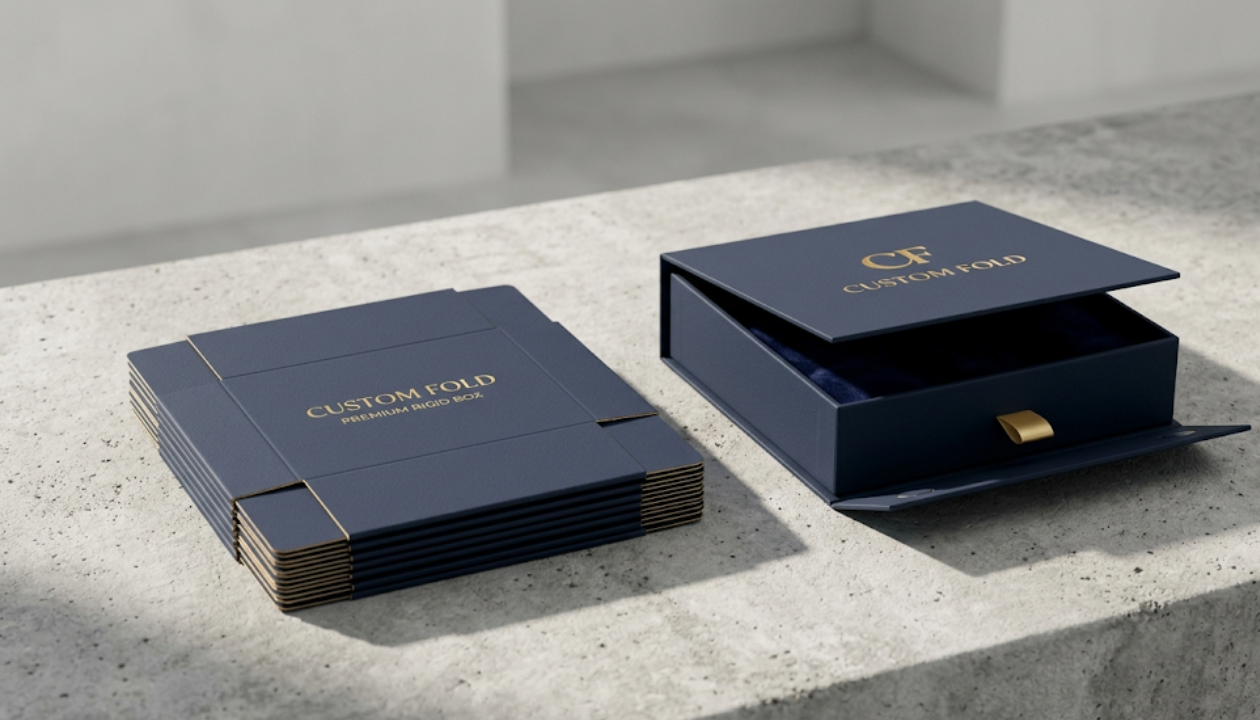







Transitioning a retail brand from standard folding cartons to luxury packaging is an operational milestone. For years, the gold standard for high-end product presentation was the traditional setup box. However, high-volume domestic shipping rates and steep warehousing fees have forced a logistical evolution. Today, logistics-conscious brands are shifting toward a highly engineered alternative: the space-saving foldable rigid box.
Navigating the design, structural sampling, and manufacturing phases of a custom packaging run can be complex for small business owners and procurement managers. Sourcing collapsible rigid boxes in USA commercial landscapes requires a clear understanding of board calipers, adhesive stability, and freight dimensions. This operational blueprint outlines the technical stages necessary to take your custom project from initial concept to a fully realized retail shelf presentation.
1. Establishing the Structural Baseline: Caliper and Material Weights
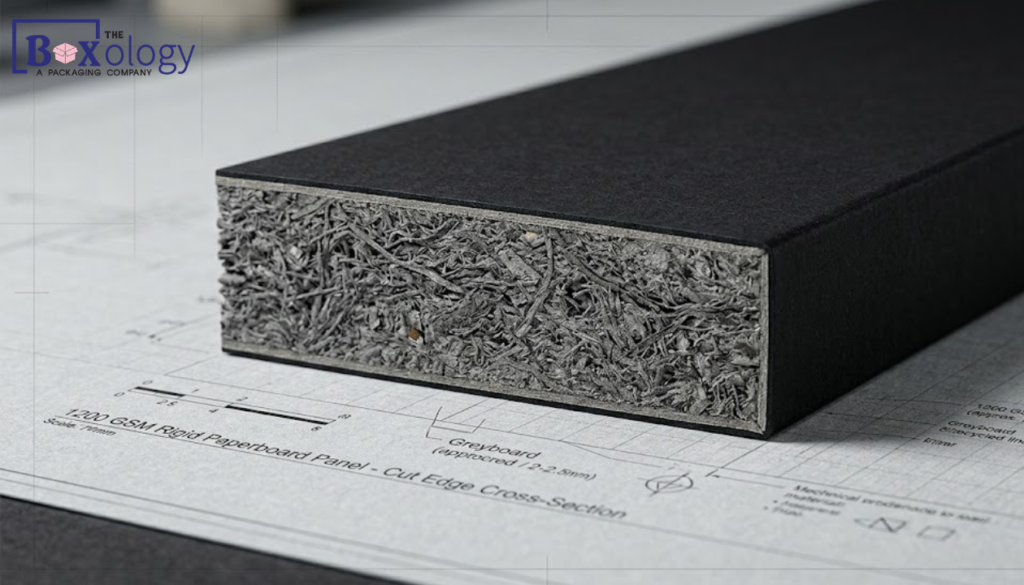
When designing custom collapsible cardboard boxes, structural integrity begins with the raw substrate. Unlike standard paperboard cartons that rely on a single layer of cardstock, a proper rigid collapsible box is a composite construction. It utilizes thick greyboard panels cut to exact dimensions, which are then laminated between custom printed liners.
What most businesses overlook is the thickness, or caliper, of the internal board. If the board is too thin, the box walls will bow under pressure when filled. Conversely, if the board is excessively heavy, the hinges will resist flat folding, increasing the risk of paper tearing at the seams.
Standard Substrate Specifications
- Luxury Weight (1200–1500 GSM): Equivalent to a 2.5mm to 3.0mm thickness. This is recommended for electronics, dense cosmetics, and heavy apparel gift sets. It provides a dense, solid feel upon unboxing.
- Standard Commercial Weight (1000–1200 GSM): Approximately 2.0mm thickness. This is a practical, cost-effective balance for most e-commerce subscription formats and midweight retail goods.
- Lightweight/Economical (800–1000 GSM): Approximately 1.5mm thickness. Best reserved for very light items like gourmet confections or small jewelry items where vertical crush resistance is less critical.
2. Navigating the Sourcing Landscape: Domestically Stocked vs. Fully Custom Runs
Before signing a manufacturing contract, you must evaluate the scale of your current product rollout. Many independent retailers search for custom rigid boxes no minimum options to execute small beta tests or seasonal product promotions. Understanding how rigid box companies structure their production lines will help you avoid unnecessary setup fees.
Ready-Made Stock Programs
For fast turnarounds, utilizing pre-manufactured blanks is a reliable route. A supplier stocks standard sizes of a unprinted rigid gift box in foundational neutral tones, such as white, cream, or matte black. These blanks are then customized post-production using hot foil stamping or precision screen printing. This methodology dramatically reduces minimum volume thresholds and shortens lead times to days instead of weeks.
Fully Custom Structural Runs
When your product demands a non-standard footprint, an unconventional depth, or specialized interior divisions like customized product cavities, a full production run is mandatory. This process utilizes automated die-cutting machinery to manufacture a dedicated custom collapsible boxes pattern from scratch. While the initial investment is higher, the per-unit cost drops significantly at higher quantities, making it the preferred method for established retail distributions.
3. Structural Comparison: Selecting Your Base Layout
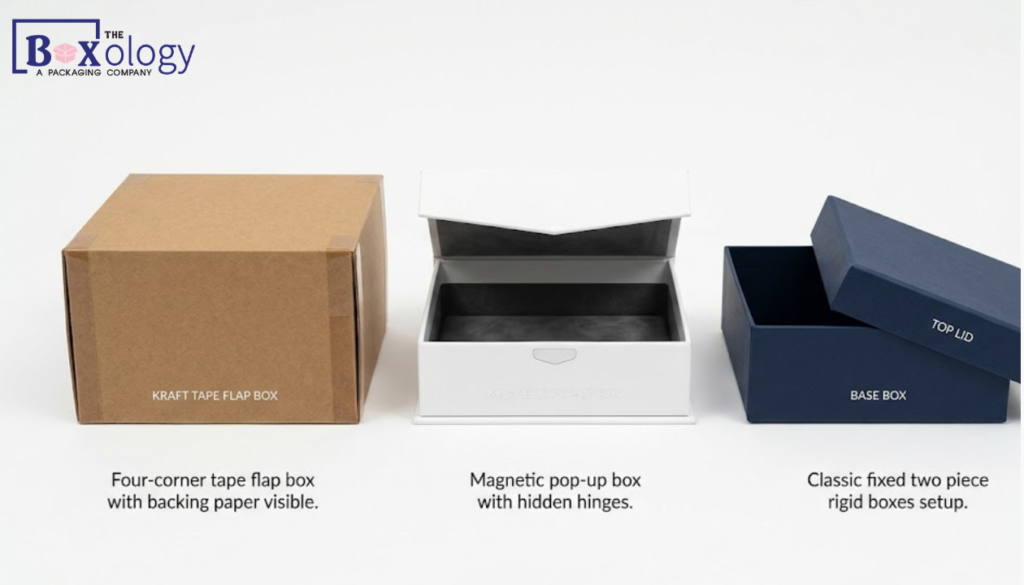
Choosing the correct opening style alters both the final assembly labor and the end consumer’s tactile experience. The table below outlines the primary structural variations available when procurement teams source collapsible rigid boxes in USA factories.
| Packaging Architecture | Assembly Mechanism | Best Visual Application | Mechanical Considerations | Logistics Footprint |
|---|---|---|---|---|
| Four-Corner Tape Flap | Built-in pressure-sensitive adhesive corners | High-end gift packaging, luxury footwear | Tape must feature an acrylic base to prevent dry-out | Ships flat, maximizes pallet density |
| Magnetic Pop-Up Box | Integrated hidden corner magnets | Premium electronics, modular cosmetics | Magnets must be precisely polarized to align instantly | Low storage volume, fast assembly |
| Traditional Two Piece Rigid Boxes | Fixed, non-collapsible lid and base shell | High-volume luxury confections, jewelry | Zero assembly labor required, but occupies massive storage space | Bulk air shipping, expensive freight |
| Ribbon-Tied Fold Up Boxes | Direct slotting panels secured with woven satin | Premium bridal kits, custom curated gift boxes | High manual labor component required to tie each unit | Flat-packed, minimal storage weight |
4. The Engineering of the Front Flap: Magnetic Closure Integration
The signature feature of a modern rigid magnetic gift box is the seamless, tool-free closure mechanism. This effect is achieved by concealing heavy-duty magnets within the front lip of the container lid and the corresponding wall panel.
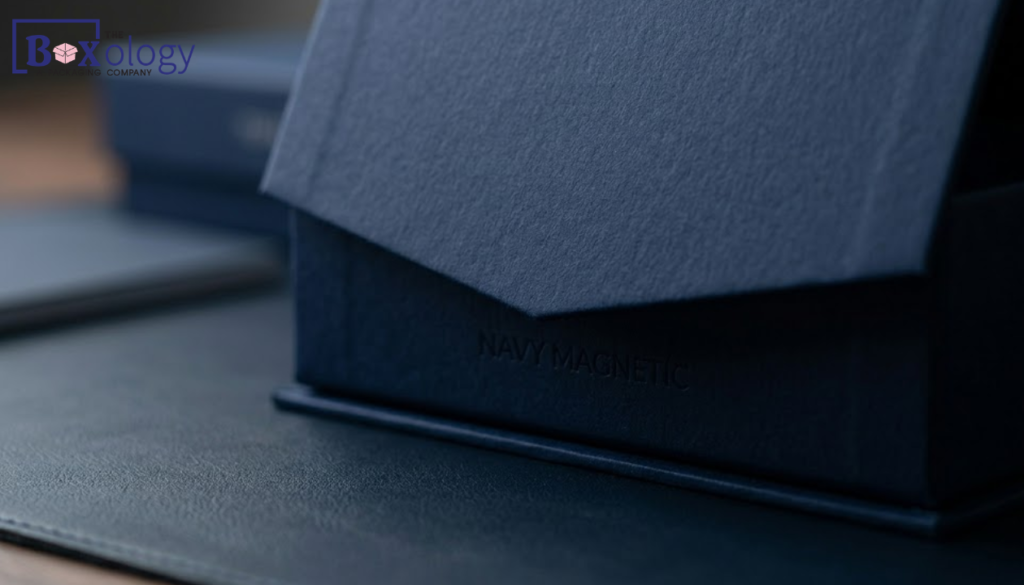
During the lamination phase of a custom printed rigid boxes run, precise pocket recesses are routed directly into the greyboard panels. The magnets are seated into these pockets before the final outer liner paper is wrapped over the surface.
[Exterior Liner Paper Layer] -> Covers the assembly completely
   [Embedded Polarized Magnet] -> Seated inside the routed board cavity
[Dense Structural Greyboard] -> Core thickness of the box wall
If the manufacturer fails to precisely align the polarity of these magnets across both panels, the lid will shift laterally or fail to snap tight, ruining the premium unboxing experience.
5. Pre-Production Protocols: Sampling and Verification
Never proceed straight to a full wholesale production run based on a digital PDF proof alone. Human error, minor dimension discrepancies, and material variances can only be detected through physical prototyping. A professional workflow requires two specific sampling stages:
- The CAD Plain Sample: This is an unprinted structural mockup cut directly on a plotting table using the exact greyboard caliper specified for your project. This sample allows you to verify that your product fits comfortably inside the collapsible rigid box cavity without shifting, and that the folding hinges move cleanly without buckling.
- The Digitally Printed Press Proof: This sample demonstrates how your custom artwork interacts with the chosen paper texture. It allows your design team to check text legibility, color accuracy, and ensure that logos do not accidentally wrap uncomfortably across a primary folding crease.
6. Streamlining Fulfillment Assembly Lines
While a folding rigid box saves a massive amount of storage space compared to fixed boxes, it does introduce a manual assembly step to your fulfillment operation. To ensure this step does not create a bottleneck in your shipping department, optimizing the assembly workflow is highly practical.
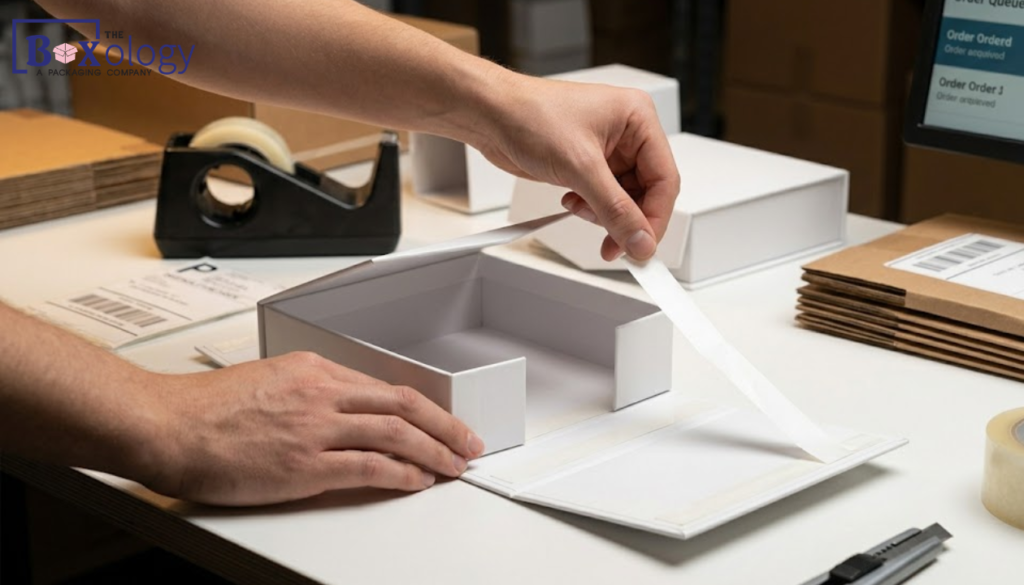
Unpack Flat Bundle -> Peel Corner Release Tape -> Erect Side Walls -> Apply Firm Pressure to Corners -> Insert Product -> Snap Magnetic Lid Closed
Train your packing staff to apply steady, firm pressure to the internal adhesive triangles for at least three seconds upon erection. This pressure fully activates the chemical bond, preventing the walls from pulling inward during subsequent handling.
7. Evaluating Structural Adhesives and Storage Environment
The longevity of a flat-shipping foldable rigid box relies completely on hidden mechanical variables that general retail brands rarely consider during design phases.
The Boxology’s Expert Insight: In my experience working with bulk manufacturers and industrial fulfillment warehouses throughout the United States, the single most common failure point for high-volume custom runs isn’t the outer paper selection—it’s the chemical stability of the corner tape. If your brand is purchasing a custom collapsible box format, you must explicitly confirm that the factory is utilizing a high-tack, pressure-sensitive acrylic adhesive rather than a standard hot-melt rubber compound. Rubber-based adhesives are highly vulnerable to the climate fluctuations found inside typical non-conditioned commercial storage facilities. Over months of storage, heat and humidity degrade rubber compounds, causing the corners of a folding shipping boxes run to spontaneously pull apart or lose grip when assembled for retail display. Acrylic alternatives cure permanently, ensuring structural stability regardless of your warehousing environment.
Procurement Checklist for Sourcing Collapsible Rigid Boxes
When finalizing your packaging specifications with domestic rigid box companies, review this quality control checklist to protect your investment:
- Liner Grain Direction: Ensure the paper grain of the liner run parallel to the primary score lines to eliminate unsightly fiber cracking on the seams.
- Crease Scoring Depth: Verify that the matrix creases are deep enough to allow a smooth 90-degree fold without causing the outer art paper to stretch or discolor.
- Magnet Pull Strength: Confirm that the closure magnets are strong enough to keep the box fully shut when the container is held upside down with a realistic product weight inside.
- Release Liner Extensions: Check that the paper backing strips on the corners feature extended pull-tabs, allowing warehouse assemblers to quickly remove them without using utility knives.
Final Thoughts for Operational Logistics
Adopting a smart collapsible rigid box strategy allows luxury brands to align their premium presentation goals with sound financial logic. By eliminating the necessity of paying to ship and store empty structural space, growing businesses can allocate resources directly toward material refinements, print embellishments, and local customer acquisition.
Many of our clients at The Boxology.US find that making the structural switch away from rigid, fixed-wall options immediately lowers their total cost of logistics while maintaining the premium unboxing experience their customers expect. Whether you are scaling an existing direct-to-consumer e-commerce brand or designing a custom retail rollout from the ground up, a properly engineered folding box delivers measurable efficiency to your bottom line.
Ready to Refine Your Brand’s Packaging Architecture?
Developing a reliable, cost-effective packaging pipeline requires precision and seasoned technical oversight. If you are preparing to map out your next production run, reach out to our structural design team at The Boxology.US for a Free Structural Consultation. Let’s review your exact dimensions, product weights, and supply chain constraints together to construct a dependable packaging blueprint for your brand.


