 Skip to content

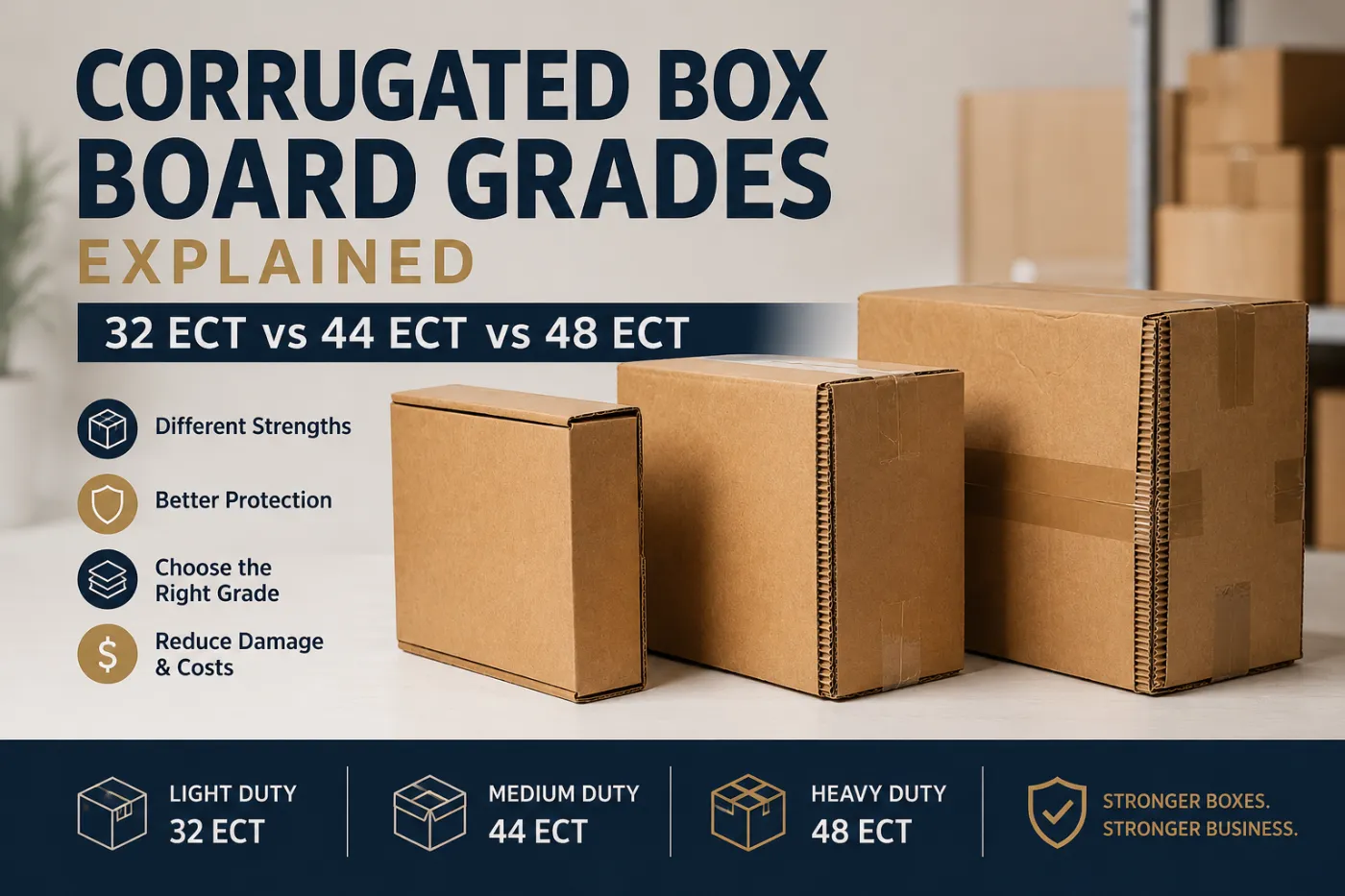







Selecting the right corrugated board grade is one of the most important decisions when designing shipping and retail packaging. Many businesses assume that a thicker corrugated box automatically provides better protection, but that’s not always true. The strength of a corrugated box depends on several factors, including its board grade, flute profile, structural design, and intended shipping conditions.
Among the most common board grades used in the packaging industry are 32 ECT, 44 ECT, and 48 ECT. Each offers a different level of compression strength and is designed for specific product weights, stacking requirements, and transportation environments. Choosing the wrong grade can increase shipping costs, damage products during transit, or result in paying for unnecessary strength that your products don’t actually require.
Having worked on custom corrugated packaging projects for ecommerce retailers, manufacturers, and wholesale distributors, I’ve found that selecting the correct board grade is just as important as choosing the right box dimensions. A properly engineered corrugated box protects products, improves warehouse stacking performance, and reduces costly shipping damage. Understanding current corrugated packaging trends can also help businesses select stronger and more efficient packaging solutions.
In this guide, we’ll explain how 32 ECT, 44 ECT, and 48 ECT corrugated box board grades differ, where each grade performs best, and how to choose the right option for your packaging requirements. Businesses investing in custom corrugated boxes should select board grades that match their product weight, shipping environment, and storage requirements.

Quick Answer
What is the difference between 32 ECT, 44 ECT, and 48 ECT corrugated box board grades?
The primary difference between 32 ECT, 44 ECT, and 48 ECT is their edge crush strength, which measures how much stacking pressure a corrugated box can withstand before collapsing. 32 ECT is commonly used for lightweight ecommerce and retail packaging, 44 ECT provides greater strength for medium-weight products and warehouse stacking, while 48 ECT is designed for heavy-duty industrial shipments and products requiring maximum compression resistance.
Key Takeaways
- 32 ECT is ideal for lightweight ecommerce shipments.
- 44 ECT offers improved stacking strength for heavier products.
- 48 ECT is designed for industrial and export packaging.
- Higher ECT ratings improve compression strength but don’t always mean thicker material.
- Selecting the correct board grade reduces damage while controlling packaging costs.
In This Guide
In this article, you’ll learn:
- What corrugated box board grades actually mean.
- How the Edge Crush Test (ECT) works.
- The differences between 32 ECT, 44 ECT, and 48 ECT.
- Which board grade is best for different industries.
- Common mistakes businesses make when selecting corrugated packaging.
- How to choose the right board grade for your products.
What Are Corrugated Box Board Grades?

Corrugated box board grades are standardized ratings that indicate the compression strength and structural performance of corrugated packaging. Rather than simply measuring thickness, these grades evaluate how much force a corrugated board can withstand when pressure is applied vertically to its edge.
This measurement helps packaging engineers determine whether a corrugated box is suitable for shipping, warehouse stacking, long-distance transportation, or export logistics.
Modern packaging manufacturers commonly use the Edge Crush Test (ECT) because it provides a more realistic indication of how boxes perform during distribution. Unlike older burst strength ratings, ECT focuses on stacking performance, which is one of the most critical factors affecting corrugated shipping boxes.
For businesses shipping products through carriers such as UPS, FedEx, USPS, or freight networks, understanding board grades helps balance product protection with shipping efficiency. If you’re new to packaging, our corrugated packaging boxes guide explains the fundamentals of board construction, flute types, and box styles.
Understanding the Edge Crush Test (ECT)

The Edge Crush Test (ECT) measures the amount of vertical force a corrugated board can withstand before its structure begins to collapse. During testing, a small sample of corrugated board is placed vertically inside a compression testing machine. Pressure is gradually applied until the board buckles.
The result is expressed as pounds per inch (lb/in), which becomes the ECT rating—for example, 32 ECT, 44 ECT, or 48 ECT.
Unlike burst strength tests that measure resistance to punctures, the Edge Crush Test evaluates a box’s ability to remain stable while stacked in warehouses, shipping containers, and delivery trucks. Because modern supply chains rely heavily on stacked pallet loads, ECT has become the preferred performance standard for most corrugated packaging applications.
From a packaging engineering perspective, ECT should never be considered in isolation. Box dimensions, flute profile, board construction, product weight, and shipping distance all influence how well a corrugated package performs in real-world conditions. The Fiber Box Association (FBA) provides industry guidance on corrugated packaging performance, including Edge Crush Test (ECT) classifications and box design best practices.
What Is 32 ECT Corrugated Board?
32 ECT is the industry standard for most ecommerce shipping boxes and lightweight retail packaging. It provides an excellent balance between strength, weight, and production cost, making it the most commonly used corrugated board grade for everyday shipping applications.
Businesses shipping apparel, cosmetics, electronics accessories, subscription boxes, books, and other lightweight consumer goods often rely on 32 ECT corrugated boxes because they provide sufficient stacking strength without increasing packaging costs.
Benefits
- Lightweight yet durable.
- Cost-effective for large production runs.
- Excellent print quality.
- Ideal for ecommerce fulfillment.
- Compatible with custom die-cut packaging.
Best Applications
- Ecommerce packaging
- Subscription boxes
- Cosmetic packaging
- Apparel shipping
- Consumer products
- Retail display packaging
Many ecommerce brands choose corrugated mailer boxes manufactured with 32 ECT board because they provide excellent protection while keeping shipping costs under control.

What Is 44 ECT Corrugated Board?
44 ECT corrugated board offers greater compression strength than 32 ECT and is designed for medium to heavy-weight products that require better stacking performance during storage and transportation.
While 32 ECT is suitable for most standard ecommerce shipments, 44 ECT is commonly selected when products are heavier, pallets are stacked higher in warehouses, or shipments travel longer distances through multiple distribution centers.
From a packaging engineering perspective, 44 ECT provides an excellent balance between strength and material efficiency. It increases vertical compression resistance without significantly increasing the overall weight of the packaging, helping businesses reduce shipping damage while maintaining reasonable freight costs.
Benefits
- Higher stacking strength.
- Better protection for medium-weight products.
- Improved warehouse performance.
- Greater resistance to compression during transport.
- Suitable for longer shipping routes.
Best Applications
- Kitchen appliances
- Electronics
- Automotive parts
- Bulk consumer goods
- Industrial components
- Multi-product ecommerce shipments
Packaging Engineer’s Insight
A common misconception is that switching from 32 ECT to 44 ECT automatically solves every shipping issue. In reality, the box design, flute profile, and internal support are equally important. A poorly designed 44 ECT box may still fail during transit, while a properly engineered 32 ECT box can often outperform it for lighter products.
What Is 48 ECT Corrugated Board?
48 ECT corrugated board is a heavy-duty packaging grade developed for products that experience significant stacking pressure, rough handling, or extended transportation. It provides exceptional compression strength and is commonly used in industrial packaging, export shipments, and high-value equipment.
Businesses shipping machinery, large electronics, commercial equipment, or dense products often choose 48 ECT because the packaging must withstand demanding logistics environments without collapsing.
Although stronger board grades improve durability, they also increase packaging costs. Using 48 ECT for lightweight products usually provides little practical benefit and may unnecessarily increase production expenses. For heavier products, our article on double wall corrugated boxes explains when multiple board layers provide additional protection.
Benefits
- Maximum compression strength.
- Excellent pallet stacking performance.
- Superior protection for export shipments.
- Reduced risk of box deformation.
- Ideal for heavy-duty logistics.
Best Applications
- Export packaging.
- Industrial equipment.
- Heavy machinery parts.
- Commercial electronics.
- Warehouse pallet shipments.
- High-value products requiring maximum protection.
Heavy industrial shipments often require corrugated shipping boxes built with stronger board grades to withstand demanding transportation conditions.
Packaging Engineer’s Insight
For export packaging, selecting 48 ECT alone isn’t enough. Factors such as moisture resistance, pallet configuration, shipping duration, and container loading conditions should also be considered during the packaging design process.
32 ECT vs 44 ECT vs 48 ECT: Key Differences
| Feature | 32 ECT | 44 ECT | 48 ECT |
| Compression Strength | Good | Very Good | Excellent |
| Product Weight | Light | Medium | Heavy |
| Warehouse Stacking | Standard | High | Very High |
| Shipping Distance | Domestic | Domestic & Regional | Export & Industrial |
| Cost | Lowest | Medium | Highest |
| Common Use | Ecommerce | Retail & Industrial | Heavy-Duty Logistics |
Expert Tip: Choose the board grade based on actual shipping requirements, not simply the highest strength available. Over-specifying packaging often increases costs without improving performance.
Which Corrugated Board Grade Should You Choose?

There isn’t a single corrugated board grade that’s best for every product. The right choice depends on how your products are stored, transported, and handled throughout the supply chain.
For lightweight ecommerce orders such as apparel, cosmetics, books, or subscription boxes, 32 ECT usually provides sufficient protection while keeping packaging costs low.
If your products weigh more, travel through multiple distribution centers, or are stacked on pallets for extended periods, 44 ECT offers improved compression strength and greater reliability.
For industrial equipment, export shipments, and heavy commercial products, 48 ECT is typically the better option because it provides the structural performance needed for demanding logistics environments. Choosing the correct board grade can also reduce transportation expenses, as explained in our guide on corrugated shipping costs.
When evaluating board grades, consider these factors:
- Product weight.
- Product dimensions.
- Shipping distance.
- Carrier handling conditions.
- Warehouse stacking height.
- Humidity and storage environment.
- Required safety margin.
Selecting the correct board grade helps reduce product damage, lower replacement costs, and avoid unnecessary spending on overly strong packaging. Material selection is equally important, and our comparison of white corrugated boxes vs kraft explains how paper choice affects both appearance and performance. Packaging evaluated using International Safe Transit Association (ISTA) testing methods is better prepared for real-world shipping and handling conditions.
Common Mistakes When Selecting Corrugated Board Grades

Choosing Strength Based Only on Thickness
Many buyers assume thicker packaging automatically means stronger packaging. In reality, flute type, paper quality, board construction, and ECT rating all contribute to overall performance.
Ignoring Shipping Conditions
A package shipped locally experiences very different handling compared to one traveling internationally. Shipping distance and handling conditions should always influence board selection.
Not Considering Product Weight
Using 32 ECT for heavy machinery or selecting 48 ECT for lightweight cosmetics both represent poor packaging decisions. The board grade should always match the product’s weight and transportation requirements.
Paying for Strength You Don’t Need
Higher ECT ratings increase manufacturing costs. Unless your products require additional compression resistance, choosing a stronger board grade than necessary may reduce profit margins without providing measurable benefits.
The Boxology Expert Insight
One of the biggest mistakes we see is businesses selecting corrugated board grades based solely on supplier recommendations or price. Effective packaging starts with understanding the product, shipping environment, and customer expectations—not simply choosing the strongest available board.
In our experience, the best-performing packaging solutions combine the correct ECT rating, an appropriate flute profile, accurate box dimensions, and well-designed structural features. When these elements work together, businesses can reduce shipping damage, optimize material usage, and improve the overall customer experience.

Final Thoughts
Choosing the right corrugated box board grade isn’t about selecting the strongest option—it’s about selecting the right option for your products and supply chain.
While 32 ECT works well for lightweight ecommerce shipments, 44 ECT provides additional stacking strength for heavier products, and 48 ECT delivers the compression resistance required for industrial and export packaging. Understanding these differences helps businesses reduce shipping damage, control packaging costs, and improve overall logistics performance. Choosing professionally engineered custom boxes helps businesses improve product protection while maintaining consistent packaging quality across every shipment.
Rather than relying solely on board thickness or price, evaluate product weight, shipping conditions, warehouse stacking, and handling requirements before selecting a board grade. A well-engineered corrugated box protects your products efficiently while avoiding unnecessary material costs. Working with an experienced corrugated packaging supplier also ensures you receive board grades that match your actual shipping requirements.
Build Stronger Packaging with The Boxology
Selecting the correct corrugated board grade is only one part of designing reliable packaging. Structural engineering, flute selection, box dimensions, printing quality, and material choice all influence how well a package performs throughout the supply chain.
At The Boxology, we manufacture custom corrugated boxes engineered for your specific products, shipping requirements, and branding goals. Whether you need ecommerce mailer boxes, retail packaging, heavy-duty shipping cartons, or custom printed corrugated packaging, our team helps you choose the right board grade for maximum performance and cost efficiency.


