Skip to content

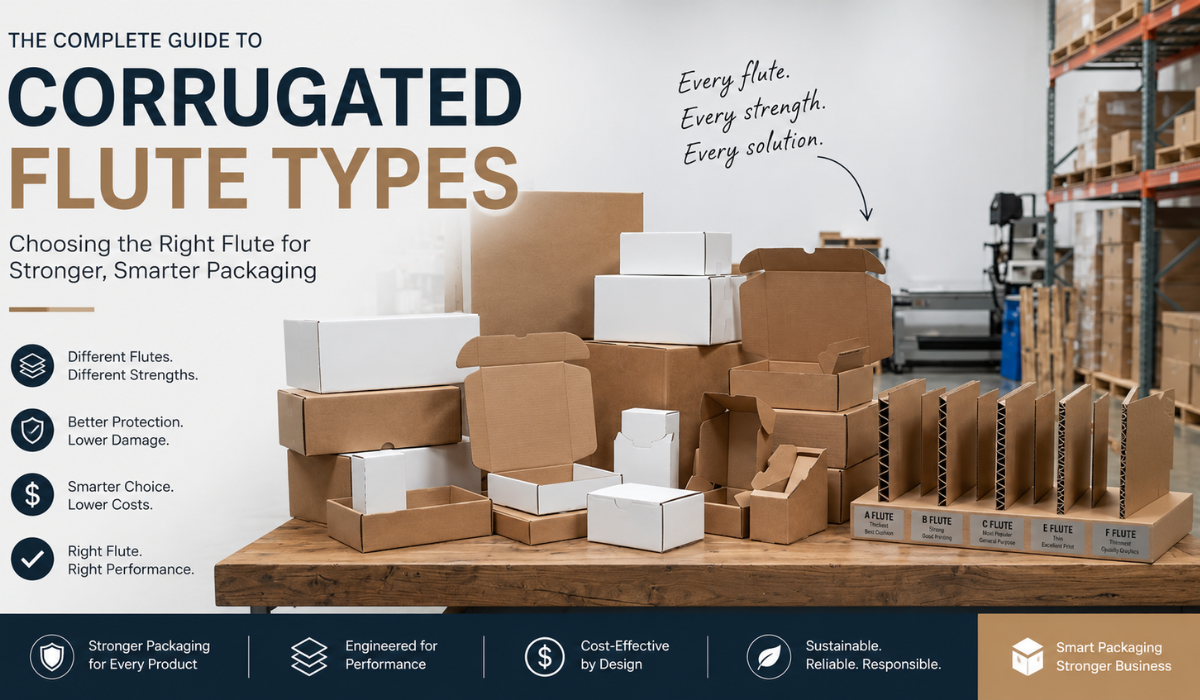







Selecting the correct corrugated flute is one of the most important decisions in packaging design, yet it’s often overlooked. Many businesses focus on box dimensions or printing quality while paying little attention to the flute profile that determines compression strength, cushioning performance, stacking ability, and print finish. The result is either over-engineered packaging that increases material costs or under-engineered boxes that fail during transportation.
In my experience managing high-volume corrugated packaging projects, flute selection directly affects manufacturing efficiency, freight performance, and customer satisfaction. Choosing the wrong flute can lead to crushed cartons, damaged products, poor print quality, and unnecessary shipping expenses. On the other hand, selecting the right flute profile creates stronger, lighter, and more cost-effective custom corrugated boxes that perform consistently throughout the supply chain.
Whether you’re packaging consumer electronics, cosmetics, industrial equipment, or e-commerce orders, understanding corrugated flute types helps you balance protection, presentation, and production costs.

Quick Answer
What are corrugated flute types?
Corrugated flute types refer to the wave-shaped paper medium positioned between the linerboards of a corrugated sheet. Different flute profiles—such as A, B, C, E, and F—vary in thickness, cushioning ability, stacking strength, and print quality. The right flute depends on the product’s weight, fragility, shipping conditions, and branding requirements. Selecting the appropriate flute ensures better product protection, efficient material usage, and improved packaging performance.
Key Takeaways
- Flute type determines box strength and cushioning.
- Different products require different flute profiles.
- Smaller flutes offer better print quality.
- Larger flutes provide improved shock absorption.
- Proper flute selection reduces product damage and shipping costs.
In This Guide
In this article, you’ll learn:
- What corrugated flute types are.
- How flute profiles influence packaging performance.
- The differences between A, B, C, E, and F flutes.
- Which flute works best for different industries.
- Common flute selection mistakes businesses make.
- Expert recommendations for choosing the right corrugated packaging.
What Are Corrugated Flute Types?
Corrugated flutes are the arched paper layers inside corrugated board that provide strength, cushioning, and structural support.
A corrugated sheet is made from three primary components:
- Outer linerboard
- Corrugated medium (flute)
- Inner linerboard
The corrugated medium forms a series of arches between the linerboards. These arches distribute pressure across the surface of the box, allowing it to withstand stacking loads while protecting products from vibration and impact during shipping.
Flute size influences several critical packaging characteristics, including:
- Compression strength
- Cushioning performance
- Print surface quality
- Material usage
- Box thickness
- Weight
- Die-cut precision
Packaging engineers evaluate flute profiles based on the product’s shipping environment rather than selecting a standard option for every application. Industry resources published by the Fiber Box Association (FBA) also emphasize selecting corrugated board specifications based on product requirements and distribution conditions.
How Corrugated Flutes Improve Box Performance
The flute profile determines how effectively a corrugated box absorbs impact, supports stacking pressure, and protects products during transportation.
Every flute creates thousands of small structural arches throughout the board. These arches increase rigidity without adding excessive material weight, making corrugated packaging one of the most efficient protective packaging solutions available.
Proper flute selection improves:
- Vertical compression strength
- Shock absorption
- Edge crush resistance
- Product stability
- Printing consistency
- Warehouse stacking performance
Packaging performance is commonly evaluated using testing methods developed by ASTM International to measure compression, durability, and material performance. What procurement managers often miscalculate during sourcing is that increasing board thickness does not always produce stronger packaging. In many applications, selecting the correct flute profile delivers better performance while reducing both material usage and freight costs. Recent corrugated packaging trends show that manufacturers are increasingly selecting flute profiles based on shipping performance rather than simply choosing thicker board constructions.
A Flute
A Flute provides excellent cushioning and is ideal for fragile products requiring superior shock absorption.
A Flute is the thickest standard corrugated profile and contains fewer flutes per foot than smaller flute types. Its deeper arches absorb impacts effectively, making it suitable for products transported over long distances or requiring additional protection.
Best Applications
- Glass products
- Ceramics
- Heavy industrial components
- Fragile retail goods
Advantages
- Excellent cushioning
- High stacking strength
- Strong compression resistance
- Superior protection during transit
Limitations
- Lower print quality compared to smaller flutes
- Uses more material
- Increased overall box thickness
B Flute
B Flute offers excellent puncture resistance and a smoother printing surface, making it a popular choice for retail and consumer packaging.
Although thinner than A Flute, B Flute provides outstanding structural stability while allowing sharper graphics and cleaner die-cut edges.
Common applications include:
- Retail packaging
- Food packaging
- Pharmaceutical cartons
- Consumer electronics
- Subscription packaging
Its balance of durability and print performance makes B Flute a preferred option for businesses that prioritize branding alongside product protection.
C Flute
C Flute is the industry’s most widely used corrugated flute because it provides an excellent balance between cushioning, stacking strength, and print performance.
If you’re unsure which flute profile to choose, C Flute is often the safest starting point. It performs well across a wide range of products and shipping conditions, making it a standard choice for custom corrugated boxes used in e-commerce, retail, and wholesale distribution.
In my experience managing nationwide packaging projects, C Flute consistently delivers reliable performance because it balances structural integrity with efficient material usage.
Best Applications
- E-commerce packaging
- Consumer goods
- Home appliances
- Subscription boxes
- General retail packaging
- Shipping cartons
Advantages
- Excellent all-around performance
- Good compression strength
- Reliable cushioning
- Suitable for automated packing lines
- Cost-effective for high-volume production
Limitations
- Not as smooth for premium printing as E Flute
- Less cushioning than A Flute for extremely fragile products
E Flute
E Flute is designed for premium retail packaging where presentation and print quality are just as important as protection.
Its thinner profile creates a smooth printing surface that supports detailed graphics, crisp typography, and premium finishing techniques.
Luxury packaging brands frequently use E Flute when designing packaging that needs both structural support and an upscale appearance.
Best Applications
- Cosmetic packaging
- Perfume packaging boxes
- Electronics accessories
- Luxury retail packaging
- Gift boxes
- Promotional packaging
Advantages
- Excellent print quality
- Lightweight construction
- Precise die-cutting
- Premium appearance
- Reduced storage space
Limitations
- Lower cushioning than larger flutes
- Less suitable for heavy industrial products
F Flute
F Flute is an ultra-thin corrugated profile developed for high-end retail packaging requiring exceptional print precision.
Although thinner than E Flute, F Flute still provides sufficient rigidity for lightweight premium products while allowing sophisticated structural designs.
Many premium packaging manufacturers use F Flute to replace traditional paperboard cartons when additional durability is required without increasing package thickness.
Best Applications
- Mobile accessories
- Luxury cosmetics
- Premium confectionery
- Pharmaceutical packaging
- Small consumer products
Advantages
- Outstanding print definition
- Slim profile
- Excellent fold quality
- Reduced material usage
- Premium shelf appearance
Limitations
- Limited cushioning
- Not recommended for heavy shipping loads
Single Wall vs Double Wall Flute Combinations
Single-wall corrugated board is suitable for most consumer products, while double-wall construction is engineered for heavier products and demanding shipping environments.
A single-wall board contains one corrugated medium positioned between two linerboards. Double-wall construction combines two flute layers with three linerboards, significantly increasing compression strength. Businesses shipping industrial equipment or export products often choose double wall corrugated boxes to improve stacking strength and reduce transit damage.
Single Wall
Best for:
- Retail products
- Apparel
- Consumer electronics
- Cosmetics
- Subscription boxes
Double Wall
Best for:
- Industrial equipment
- Automotive parts
- Heavy machinery
- Bulk shipments
- Export packaging
Although double-wall packaging offers greater durability, it also increases material consumption and shipping weight. Selecting double-wall construction only makes sense when the product’s weight and shipping conditions justify the additional strength.
Which Corrugated Flute Is Best for Your Industry?
| Industry | Recommended Flute | Reason |
| E-commerce | C Flute | Balanced protection and cost efficiency |
| Electronics | E Flute | Better print quality with adequate protection |
| Luxury Packaging | E Flute / F Flute | Premium appearance and precision printing |
| Food & Beverage | B Flute | Strong puncture resistance |
| Heavy Industrial Products | A Flute / Double Wall | Maximum cushioning and compression strength |
| Subscription Boxes | C Flute | Excellent balance of durability and presentation |
| Cosmetic Packaging | E Flute | High-quality graphics and premium finish |
Structural strength is only one part of effective packaging. The most successful corrugated box designs balance protection, branding, and manufacturing efficiency.
The Boxology’s Expert Insight
One mistake we frequently see during packaging consultations is businesses selecting flute profiles based solely on box thickness. A thicker board does not automatically provide better protection. Product weight, shipping distance, stacking conditions, and warehouse handling should all influence flute selection. In many cases, switching from an oversized flute to a properly engineered profile reduces material costs while maintaining equal—or even better—shipping performance. Testing prototypes before full production is one of the most effective ways to optimize both packaging performance and manufacturing costs.
Comparison Table
| Flute Type | Thickness | Cushioning | Print Quality | Compression Strength | Best For |
| A Flute | High | ★★★★★ | ★★☆☆☆ | ★★★★★ | Fragile & heavy products |
| B Flute | Medium | ★★★☆☆ | ★★★★☆ | ★★★★☆ | Food, retail, consumer goods |
| C Flute | Medium-High | ★★★★☆ | ★★★☆☆ | ★★★★★ | General shipping & e-commerce |
| E Flute | Thin | ★★☆☆☆ | ★★★★★ | ★★★☆☆ | Luxury retail & cosmetics |
| F Flute | Ultra Thin | ★★☆☆☆ | ★★★★★ | ★★☆☆☆ | Premium lightweight packaging |
Common Corrugated Flute Selection Mistakes
Selecting the correct flute profile requires more than comparing board thickness. Businesses that rely on assumptions instead of packaging requirements often experience unnecessary freight costs, damaged shipments, or inefficient production.
Choosing the Thickest Flute for Every Product
A common misconception is that thicker always means stronger.
In reality, oversized flute profiles may increase material costs, consume additional warehouse space, and raise dimensional shipping charges without providing meaningful improvements in product protection.
The ideal flute should match the product’s weight, fragility, and shipping environment—not simply maximize board thickness.
Ignoring Print Quality Requirements
If packaging is intended for retail display or premium branding, print quality matters as much as structural strength.
Large flute profiles may create visible washboarding that affects graphics and fine typography. For products requiring sharp printing, smaller flute profiles often produce significantly better visual results.
Overlooking Shipping Conditions
Boxes that perform well in local deliveries may not withstand long-distance transportation involving multiple distribution centers.
When analyzing shipping failures across cross-country freight networks, repeated compression loads and continuous vibration are often greater risks than individual impacts. Flute selection should reflect the complete supply chain rather than a single shipping event.Businesses shipping products nationwide often validate packaging performance using transit testing protocols developed by the International Safe Transit Association (ISTA).
Selecting Standard Packaging for Every Product
Different products require different levels of protection.
For example:
- Fragile glassware benefits from A Flute.
- Consumer electronics often perform well with E Flute.
- General e-commerce shipments commonly use C Flute.
- Food packaging frequently utilizes B Flute for its puncture resistance.
Using one flute profile across every product category rarely delivers the most efficient packaging solution.
Domestic US Manufacturing Advantages
Working with a U.S.-based corrugated packaging manufacturer provides faster lead times, better quality control, and more efficient communication throughout the production process.
Businesses sourcing custom corrugated boxes domestically often benefit from:
- Faster production turnaround
- Lower domestic freight costs
- Easier prototype revisions
- Consistent material availability
- Improved quality assurance
- Better customer support
- Lower risk of production delays
In my experience managing wholesale packaging programs, early prototype testing and structural reviews eliminate many of the production issues that become expensive after full-scale manufacturing begins.
For growing brands, shorter lead times often provide greater operational value than small savings achieved through overseas sourcing. Partnering with an experienced corrugated packaging supplier also makes prototype development and quality control significantly easier.
Final Thoughts
Choosing the right corrugated flute profile is one of the most important decisions in packaging engineering. While flute size may seem like a minor specification, it directly affects box strength, cushioning performance, print quality, warehouse efficiency, and shipping costs.
A Flute delivers superior cushioning for fragile products, B Flute balances puncture resistance with print performance, C Flute remains the most versatile option for general shipping, and E and F Flutes provide the refined appearance required for premium retail packaging.
Rather than selecting a flute based solely on thickness, businesses should evaluate product weight, transportation conditions, branding requirements, and production efficiency together. The right combination of flute profile and structural design results in packaging that protects products while optimizing material usage and freight expenses.
Well-engineered custom corrugated boxes are built around these decisions, ensuring reliable performance from the production floor to the customer’s doorstep. For products requiring nationwide transportation, professionally engineered custom corrugated shipping boxes provide additional durability while helping businesses optimize freight efficiency.
Build Stronger Packaging with the Right Corrugated Flute
Selecting the correct flute profile is the foundation of reliable packaging performance. Whether you’re shipping consumer products, industrial equipment, or premium retail goods, the right corrugated structure helps reduce damage, improve efficiency, and control packaging costs.
At The Boxology, we engineer custom corrugated boxes designed around your product’s exact shipping and protection requirements. From flute selection and board grade recommendations to structural testing and custom prototypes, our packaging specialists help businesses develop solutions that perform consistently across every stage of the supply chain.