Skip to content




Jewelry packaging has two jobs that have to work together: protect the product and present it properly.
A necklace can arrive tangled. A ring can shift inside an oversized cavity. A delicate earring can become loose when the insert does not provide enough retention. These problems are rarely caused by the outer box alone. They usually come from a mismatch between the jewelry, insert, box structure, and handling conditions.
For jewelry brands, good packaging starts with the product itself. The box style, board construction, insert geometry, finishes, and dimensions should be developed as one packaging system.
For brands evaluating different jewelry boxes, the right structure depends on the product, insert requirements, presentation goals, and fulfillment conditions.
This guide covers practical jewelry packaging ideas for brands evaluating box styles, inserts, materials, branding, and structural requirements.
What Makes Jewelry Packaging Effective?
An effective jewelry package should look premium when the customer opens it and remain structurally reliable throughout fulfillment and transportation.
The design process should begin with the physical characteristics of the jewelry.
Consider:
- Product dimensions and weight
- Jewelry shape and delicate components
- Required retention points
- Insert material and caliper
- Box construction
- Closure mechanism
- Internal clearances
- Shipping and handling conditions
- Branding and finishing requirements
A common packaging mistake is designing the exterior first and trying to make the insert fit afterward.
For custom jewelry packaging, the insert and product cavity should be considered during the structural design stage. This allows the dieline, internal dimensions, and external footprint to work together instead of creating compromises later in production.
Packaging Engineer Insight
A jewelry box is not just a container. It is a retention system, presentation system, and brand touchpoint in one structure.
That distinction becomes especially important when a brand moves from small quantities to larger production runs. A cavity that looks acceptable on a prototype may expose tolerance or assembly problems when thousands of units are produced.
Jewelry Packaging Ideas Based on Product Type
There is no universal jewelry box structure that works equally well for every product.
The jewelry’s dimensions and geometry should determine the internal packaging architecture.
Ring Boxes
Ring packaging usually requires a narrow retention cavity that holds the ring securely while keeping the stone or setting visible.
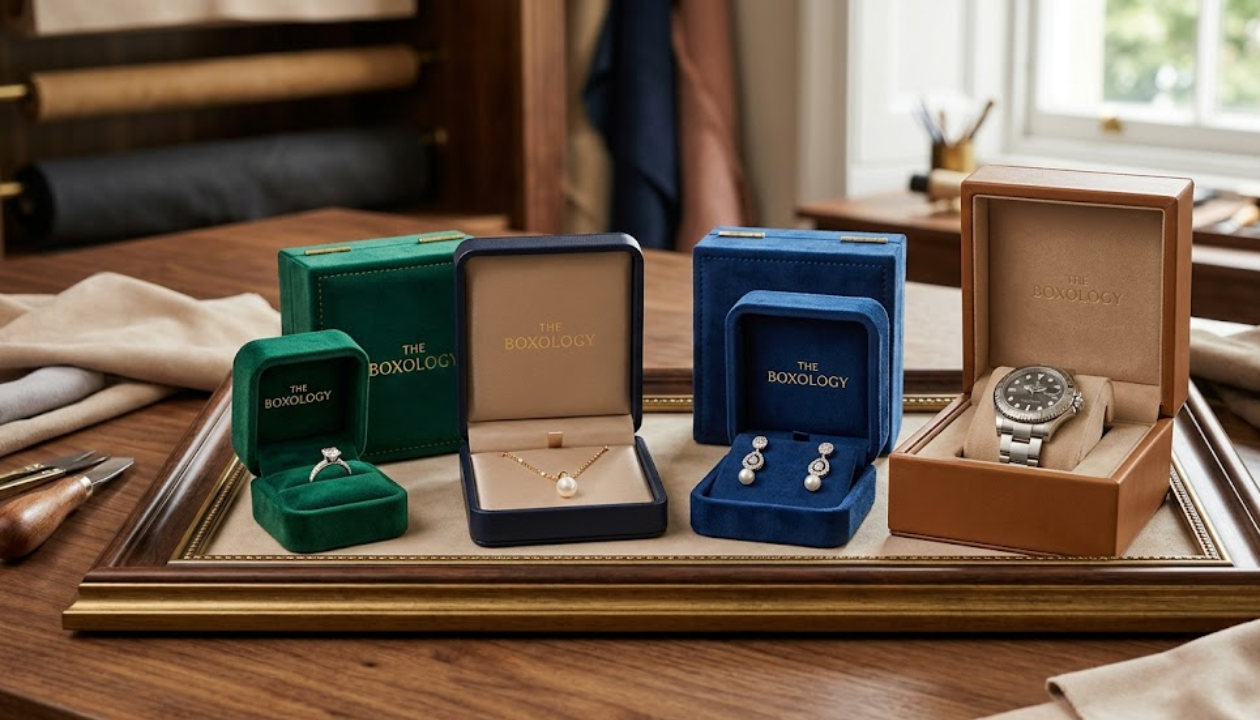
For premium presentation, a rigid ring box with a fabric-covered insert can create a strong luxury appearance.
The cavity should not simply be oversized to accommodate different ring sizes. Excessive clearance can allow the ring to move during handling.
For collections with significant product variation, brands should determine the acceptable dimensional range before finalizing the insert tooling.
For more examples of current ring packaging structures and presentation approaches, see our ring box packaging guide.
Necklace & Pendant Boxes
Necklaces create a different structural challenge because the chain can move independently from the pendant.
A good necklace packaging design may use:
- Chain slots
- Retention tabs
- Hooks
- Folded paperboard supports
- Dedicated pendant cavities
The objective is to control movement without making the jewelry difficult for the customer to remove.
For longer chains or larger pendants, the internal footprint may need to increase even when the jewelry itself is lightweight.
Earring Boxes
Earrings require accurate positioning because pairs should remain aligned and visible.
Small die-cut openings, fabric-covered boards, foam, or molded components can be used depending on the product and presentation requirements.
For stud earrings, the retention feature should hold the backing and jewelry securely without creating unnecessary pressure on delicate components.
Bracelet & Bangle Boxes
Bracelets and bangles generally need a wider support area than rings.
A shaped insert can keep the product centered and prevent it from moving against the interior walls.
Heavier bangles also require attention to insert compression and attachment points. A lightweight insert that works for a small bracelet may not provide adequate support for a heavier product.
Multi-Piece Jewelry Sets
Jewelry sets often require multiple cavities within one structural footprint.
Separate compartments can prevent necklaces, earrings, rings, and bracelets from contacting each other.
The layout should also consider the opening sequence. The customer should be able to see and access each piece without removing the entire insert.
Custom Jewelry Packaging Ideas for Brands
Custom packaging becomes valuable when a brand needs more control over product fit, presentation, or brand consistency.
Instead of adapting the product to an off-the-shelf box, the packaging can be developed around the actual jewelry collection.
Brands looking for a deeper overview of structural customization can explore our custom jewelry boxes guide.
Build the Structure Around the Product
Start with accurate product dimensions.
Measure the jewelry in its intended packaged position, including chain length, pendant height, ring profile, earring backing, or bracelet diameter.
These measurements help establish the internal cavity and clearance requirements.
The outer dimensions can then be developed around the insert rather than guessed independently.
Use Branding With Purpose
A logo does not need to appear on every surface.
For premium jewelry packaging, controlled branding can often create a stronger result. The lid, interior panel, insert cover, or closure can each become a deliberate branding location.
The placement should be checked against the final dieline so the logo does not fall across folds, seams, closures, or structural transitions.
Custom Colors and Finishes
Color can establish immediate brand recognition.
Finishing options may include:
- Matte lamination
- Soft-touch coating
- Foil stamping
- Embossing
- Debossing
- Spot finishes
- Printed interior panels
However, premium packaging does not mean using every available finish.
The best combination depends on the brand positioning, artwork, substrate, production volume, and target cost.
Print Registration Matters
When packaging uses multiple finishing processes, print registration becomes important.
Small shifts between printed graphics, foil, embossing, and die-cut features can become noticeable on a compact jewelry package.
For that reason, artwork and structural tolerances should be reviewed together before production approval.
Jewelry Box Insert Ideas
The insert is often the component that determines whether the jewelry arrives neatly positioned or moves around inside the package.
Insert selection should consider both retention and presentation.
Velvet and Fabric-Covered Inserts
Fabric-covered inserts are frequently used for premium jewelry because they provide a soft contact surface and a refined appearance.
Velvet can work particularly well for luxury collections where the interior presentation is part of the perceived product value.
The underlying insert structure still matters. A premium fabric surface cannot compensate for an incorrectly sized cavity or weak retention system.
Foam Inserts
Foam is useful when additional cushioning or precise product retention is required.
Different foam densities provide different levels of support and compression resistance.
The correct density depends on the product weight, cavity design, packaging construction, and expected handling conditions.
Using unnecessarily soft foam can allow movement. Using excessively firm material can make product removal difficult or create unwanted pressure.
Die-Cut Paperboard Inserts
Die-cut paperboard offers considerable structural flexibility.
Slots, tabs, cavities, dividers, and folded supports can be developed around specific jewelry dimensions.
For brands producing multiple SKUs, paperboard inserts can also provide opportunities for standardized structures with product-specific cavity configurations.
Dividers and Multiple Compartments
Multi-product packaging often benefits from dedicated compartments.
Dividers can separate products and control movement while creating a more organized presentation.
The divider height should be evaluated against the jewelry profile. A divider that is too low may provide limited separation, while an unnecessarily high divider can interfere with presentation.
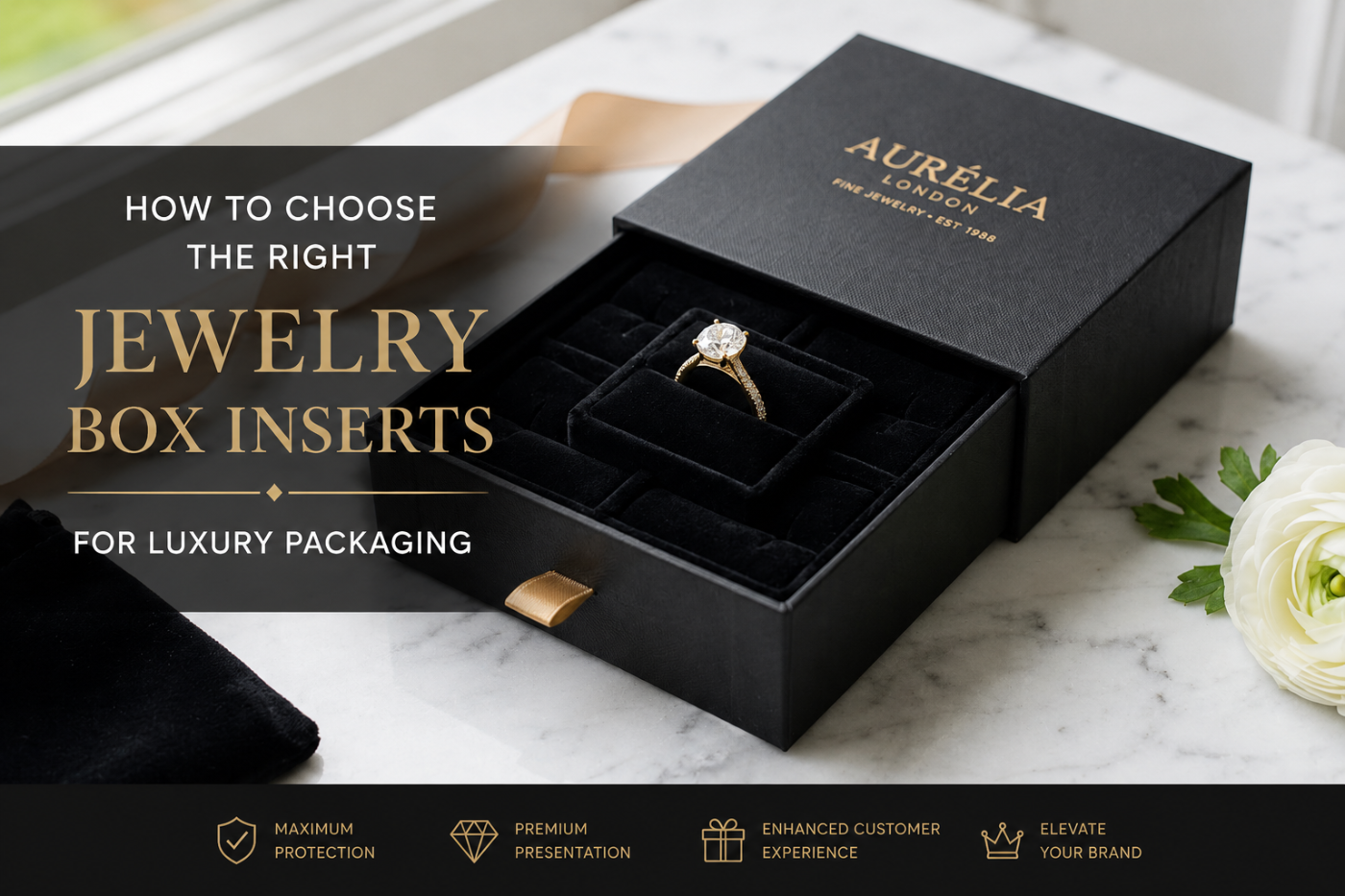
For a deeper discussion of retention structures and insert materials, brands can refer to the existing Jewelry Box Inserts Guide.
Choosing the Right Jewelry Box Material
Material selection affects much more than appearance.
Board caliper, stiffness, surface finish, weight, folding behavior, and production method all influence the final package.
Rigid Board
Rigid board is a strong option for premium jewelry packaging.
Its substantial hand feel can support luxury positioning, while the construction allows structures such as:
- Two-piece rigid boxes
- Magnetic closure boxes
- Drawer boxes
- Hinged-lid boxes
- Book-style boxes
Rigid packaging can also provide a stable platform for premium wraps and finishing processes.
However, rigid construction is not automatically the best choice for every application. Brands should consider product value, packaging volume, shipping requirements, assembly, and target cost before selecting the structure.
Paperboard
Paperboard packaging can be suitable for lightweight jewelry packaging, promotional collections, and brands looking for efficient material usage.
Its structural flexibility allows a wide range of folding carton and insert configurations.
The board grade and caliper should be matched to the package dimensions and product requirements rather than selected solely by appearance.
Kraft Materials
Kraft packaging can support a natural, understated brand aesthetic.
It can work particularly well with minimalist printing and paper-based inserts.
For brands positioning packaging around sustainability, material claims should be evaluated carefully. The actual construction, coatings, adhesives, inks, and local recycling infrastructure can all affect end-of-life considerations.
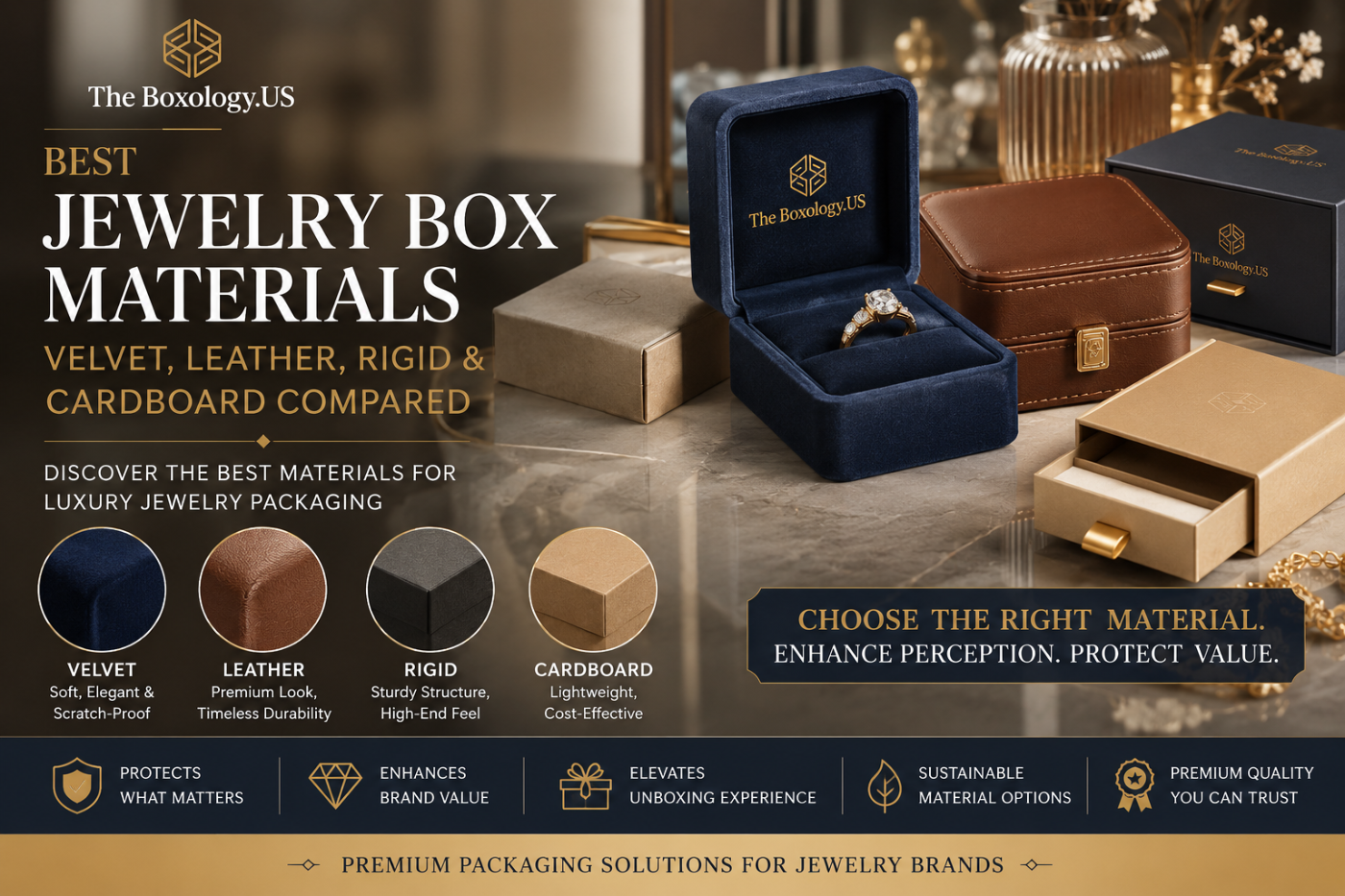
For a detailed comparison of jewelry box materials, see our Best Jewelry Box Materials Compared guide
Luxury Jewelry Packaging Ideas
Luxury packaging is primarily about controlled presentation and structural precision, not simply expensive materials.
A premium box should open cleanly, maintain alignment, hold the jewelry securely, and feel intentional in the customer’s hands.
Brands exploring current structural and finishing directions can also review the latest jewelry box trends.
Popular luxury structures include:
Magnetic Closure Boxes
Magnetic closures can create a clean opening experience while keeping the lid securely positioned.
The magnet placement, board thickness, wrap material, and closure alignment need to be coordinated during structural development.
Drawer-Style Boxes
Drawer structures create a distinctive reveal and can provide additional surface area for interior branding.
The drawer should move smoothly without excessive friction or looseness.
Two-Piece Rigid Boxes
A base-and-lid construction offers a classic premium presentation.
The fit between the lid and base is important. Excessive tolerance can make the box feel loose, while insufficient clearance can make opening difficult.
Hinged-Lid Boxes
Hinged structures can create an elegant presentation, particularly when the interior is designed as a coordinated display.
The hinge area should be considered during material selection and prototyping because repeated opening and closing places stress on the structure.
Jewelry Packaging Ideas for E-Commerce Brands
Jewelry sold online faces packaging conditions that are different from products presented directly in a retail environment.
The package may experience picking, packing, transportation, sorting, and repeated handling before reaching the customer.
That makes structural integrity especially important.
Reduce Unnecessary Movement
The insert should hold the jewelry in its intended position.
Movement inside the package can create scratches, tangling, displacement, or a poor presentation when the customer opens the box.
Control the Structural Footprint
An oversized jewelry box may increase material usage and shipping dimensions without improving product protection.
Efficient packaging aims to provide the required clearance without creating unnecessary empty space.
Consider the Outer Shipping Package
A jewelry presentation box may still require an external mailer or shipping carton.
The inner box should therefore be evaluated as part of the complete shipping system.
A beautiful presentation box does not replace appropriate transit protection.
Design for Repeatability
E-commerce brands need packaging that performs consistently across orders.
The insert should position the product repeatably, and assembly should be straightforward enough for fulfillment teams to maintain consistent presentation.
This becomes increasingly important as order volume grows.
How to Choose the Right Jewelry Packaging
Choosing a packaging structure becomes easier when the decision follows a defined sequence.
Step 1: Identify the Product Requirements
Document the jewelry dimensions, weight, shape, materials, and fragile components.
Do not design around a product photograph alone.
Step 2: Determine the Retention Method
Decide how the jewelry will stay in position.
This may involve a slot, cavity, tab, hook, foam recess, fabric support, or combination structure.
Step 3: Select the Box Style
Choose the box construction based on product requirements and brand positioning.
A simple folding structure may be appropriate for one collection, while a rigid magnetic box may be justified for a premium collection.
Step 4: Establish the Internal Dimensions
The cavity should provide sufficient clearance without allowing excessive movement.
This is where dimensional tolerances become important.
Step 5: Select the Material
Evaluate board caliper, stiffness, surface requirements, insert material, production method, and shipping conditions.
Step 6: Develop the Branding
Place logos and artwork around the final structural design.
This reduces the risk of artwork crossing folds, seams, closures, or die-cut areas.
Step 7: Prototype Before Production
A physical prototype can reveal problems that are difficult to identify on a flat dieline.
Check:
- Lid fit
- Insert retention
- Product removal
- Cavity dimensions
- Closure performance
- Print positioning
- Assembly sequence
For larger production runs, prototype evaluation can help prevent expensive tooling or manufacturing changes later.
Product dimensions should be established before finalizing the box structure; our guide to jewelry box sizes provides additional considerations for rings, necklaces, and bracelets.
Common Jewelry Packaging Mistakes
Designing the Box Before the Insert
The insert should not be an afterthought.
If the internal retention system is developed too late, the outer box may need to become unnecessarily large or structurally compromised.
Using One Insert for Every SKU
A single generic insert may not provide proper retention across products with different dimensions.
Where product variation is significant, brands should evaluate whether interchangeable or SKU-specific inserts are more appropriate.
Ignoring Material Caliper
Board thickness affects the final internal dimensions.
Even small changes in caliper can influence folding, cavity size, lid fit, and overall box dimensions.
Overlooking Assembly
A structure that looks excellent in a prototype may become inefficient when assembled at scale.
Theumber of folding steps, adhesive points, insert placement, and closure operations should be evaluated before production.
Treating Finishing as an Afterthought
Foil, embossing, coatings, and other finishes can affect the final appearance and production requirements.
They should be incorporated into the packaging specification from the beginning.
Prioritizing Appearance Over Protection
Jewelry packaging needs to look premium, but appearance cannot replace product retention.
The best packaging balances aesthetics with structural performance.
A Practical Jewelry Packaging Specification Checklist
Before approving a custom jewelry packaging project, brands should confirm:
Product
- Accurate product dimensions
- Product weight
- Fragile areas
- SKU variations
Structure
- Box style
- Internal cavity
- Insert type
- Closure mechanism
- Product retention
Materials
- Board grade
- Caliper
- Wrap material
- Insert material
- Surface treatment
Branding
- Logo placement
- Brand colors
- Interior graphics
- Finishing requirements
- Print registration
Manufacturing
- Dieline accuracy
- Setup tolerances
- Tooling requirements
- Assembly method
- MOQ
- Lead time
Shipping
- Presentation box dimensions
- Outer shipping protection
- Handling conditions
- Dimensional weight considerations
This checklist helps move the project from a visual concept toward a manufacturable packaging specification.
Final Thoughts
The strongest jewelry packaging ideas begin with a clear understanding of the product.
A successful package does not simply look attractive. It holds the jewelry securely, opens predictably, supports the brand identity, survives normal handling, and remains practical to manufacture at the required production volume.
For B2B jewelry brands, the most reliable approach is to develop the box, insert, materials, branding, and shipping requirements as one structural system.
That approach reduces design compromises and gives manufacturers clearer specifications for prototyping and production.
If your brand is developing a new jewelry packaging line, explore custom jewelry boxes designed around your products, insert requirements, branding, and production needs.