Skip to content


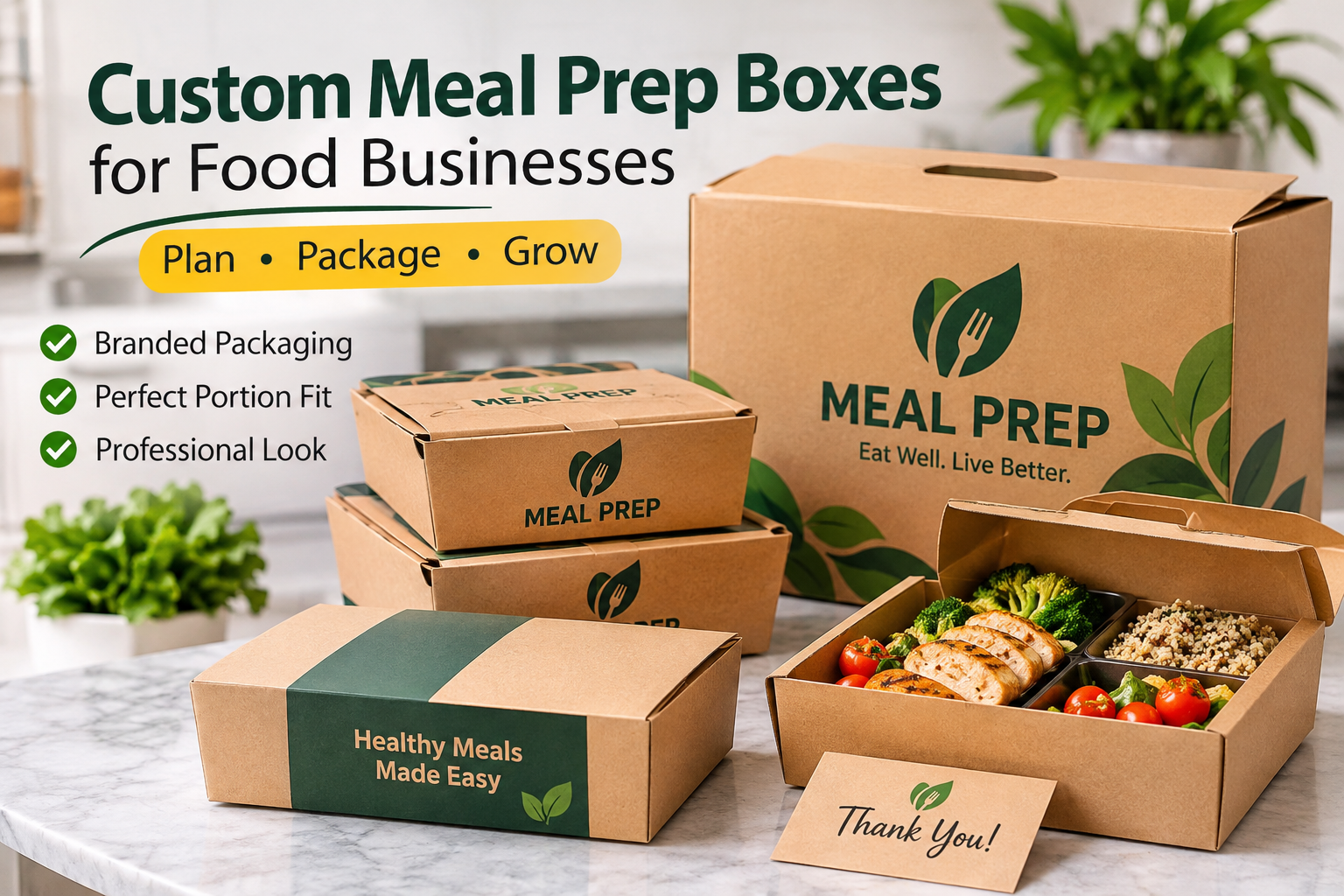


Meal prep businesses handle a different type of food packaging challenge than traditional restaurants. Instead of preparing individual orders for immediate consumption, they often organize multiple meals for weekly plans, scheduled pickups, and recurring deliveries. Each order may contain different dishes, portion sizes, and meal combinations that need to be presented consistently.
Choosing the right custom food packaging for meal prep businesses helps create a more organized customer experience while giving the brand a recognizable appearance. Packaging also needs to fit the type of food being sold, the way orders are distributed, and the business’s daily operations.
Whether you offer weekly lunch plans, prepared family meals, or individual portion-based menus, this guide explains how to plan custom food boxes around your products and business requirements.
Why Packaging Matters for Meal Prep Businesses
Meal prep packaging is part of the overall customer experience. Customers may receive several meals in one order, so the packaging should make each item easy to identify, organize, and handle.
A well-planned packaging setup can support several business needs:
- Consistent presentation: Similar packaging across different meals creates a recognizable brand experience.
- Clear meal identification: Labels and printed details help customers distinguish between dishes and meal options.
- Order organization: A planned packaging system makes it easier to group meals by customer, menu, or delivery schedule.
- Brand recognition: Custom printing gives businesses an opportunity to display their name, colors, and visual identity.
- Professional appearance: Coordinated packaging can make weekly meal collections look more organized and thoughtfully prepared.
Packaging should not be selected on appearance alone. Its structure, dimensions, and material must also suit the specific food products and handling conditions.
1. Understand Your Meal Prep Business Model
Before selecting custom food boxes, identify how your business prepares and sells meals.
A company delivering individual lunch plans may have different packaging requirements from a business supplying family-sized meal collections.
Start by identifying your primary order types.
Individual Meal Plans
These businesses prepare separate meals for customers who purchase lunch or dinner plans. Packaging needs to support clear identification and consistent presentation across multiple menu items.
Weekly Meal Subscriptions
Subscription businesses often prepare several meals together for scheduled weekly orders. Their packaging system should make it easy to group different dishes into one customer order.
Family Meal Packages
Family-sized orders may contain larger portions or multiple food items. The packaging needs to accommodate the actual product dimensions and quantity.
Corporate Meal Programs
Businesses supplying meals to offices or corporate customers may need consistent packaging across larger batches of orders.
Understanding your business model helps determine which box formats, quantities, and branding elements make sense.
If your business also handles larger food orders, explore our guide to bulk food packaging supplies for catering businesses.
2. Choose Box Dimensions Based on Actual Meal Requirements
One of the most important steps is measuring the products before ordering custom packaging.
A box that looks suitable in a design file may not provide enough room for the actual packaged food. On the other hand, unnecessarily large packaging can make orders harder to organize and handle.
Measure the complete packaged product, not just the food portion.
Consider:
- Length and width of the food container.
- Overall height, including the lid.
- Number of items packed together.
- Space required for additional components.
- How the box will be closed and handled.
For example, an individual lunch order may require a different outer box size from a weekly meal collection containing several separate containers.
Use actual product samples when checking dimensions. This helps you confirm the fit before approving a larger packaging order.
3. Select a Suitable Food Box Style
Different meal prep products may require different packaging formats. The right option depends on the food, its existing container, and the way customers receive the order.
| Packaging option | Suitable use | Main consideration |
|---|---|---|
| Individual food boxes | Separately packaged meal orders | Match dimensions to the packaged meal |
| Multi-item food boxes | Several items grouped into one order | Allow enough space for every component |
| Food trays | Suitable food presentation and serving applications | Verify the intended food use and specifications |
| Custom printed food boxes | Branded meal collections and retail presentation | Balance branding with practical requirements |
| Paper lunch bags | Certain takeaway and meal pickup orders | Check carrying needs and food compatibility |
When comparing packaging costs, businesses should also consider whether custom food trays are a suitable option for their particular food products and serving requirements.
These options serve different purposes. A custom outer box, for example, may organize a group of individually packaged meals, while a food tray may serve a more direct food presentation purpose.
Before selecting a format, confirm that its intended use matches your food product and handling requirements.
4. Plan Packaging for Multiple Meals and Menu Variations
Meal prep businesses frequently update their menus. A weekly order might include chicken meals, vegetarian options, salads, or different portion sizes.
Your packaging plan should account for these variations.
Start by creating a list of the products included in your regular menu. Record their dimensions, packaging format, and any differences that may affect the outer box.
For example:
| Meal category | Example order | Packaging planning |
|---|---|---|
| Chicken meals | Chicken with rice and vegetables | Confirm the packaged meal dimensions |
| Vegetarian meals | Vegetable and grain-based meal | Allow for its actual container size |
| Salad options | Individual salad portions | Consider the shape and height of the package |
| Family meals | Multiple portions in one order | Plan the outer packaging around all components |
This is an illustrative planning table. Actual packaging dimensions should be based on your products.
If your menu changes every week, consider whether one outer packaging format can accommodate several meal combinations. Standardizing suitable box sizes may simplify purchasing and order preparation.
However, avoid forcing every product into the same box if its dimensions or handling needs are different.
5. Make Meal Identification Clear and Easy
When customers receive several meals together, they need a simple way to identify each item.
Custom food boxes can support brand recognition, but meal identification may also require labels or additional printed information on the individual food packages.
Depending on your business model, useful information may include:
- Meal or dish name.
- Menu category.
- Portion size.
- Preparation or packing date, where applicable.
- Storage and handling instructions, where verified.
- Allergen information, where required.
- For packaged foods subject to US labeling requirements, businesses can review the FDA’s food allergen labeling guidance when preparing ingredient and allergen information.
- Customer-specific order identification.
Make sure the information is accurate and easy to read.
Do not rely on decorative packaging alone to communicate important food details. Any food labeling requirements should be checked against the regulations applicable to your products and sales locations.
6. Use Custom Printing to Build Brand Recognition
Meal prep customers may order from your business every week. Consistent packaging can help make each order recognizable and reinforce your brand identity.
Custom printed food boxes provide space to incorporate visual elements that connect the packaging with your business.
Consider including:
Brand logo: Place your logo where customers can see it without making the design crowded.
Brand colors: Use a consistent color palette across your packaging.
Typography: Select readable fonts for brand names and product information.
Simple graphics: Use design elements that reflect your food business and menu style.
Contact information: Include relevant website or ordering details where appropriate.
A clean, consistent design is often more effective than filling every available space with graphics or promotional messages.
Before finalizing the artwork, check how it looks on the actual box structure. A design that works on a flat screen may need adjustments when printed and folded.
For more inspiration on creating a recognizable food brand, read our guide to food packaging design ideas for small food brands.
7. Consider Packaging for Pickup and Delivery
Meal prep orders may be collected by customers or delivered to homes and workplaces. These distribution methods can affect packaging decisions.
For pickup orders, businesses may prioritize convenient carrying and organized presentation.
For delivery orders, the complete packaging setup should be evaluated according to the route, handling conditions, and the food’s specific requirements.
Consider the following questions:
- Will several meals be placed in one outer box?
- Can employees identify each customer’s order quickly?
- Is the packaging practical to carry?
- Will the packaged meals remain organized during normal handling?
- Does the selected structure suit the intended distribution method?
Remember that a custom food box is not automatically insulated, leakproof, microwave-safe, or suitable for direct food contact. These properties must be confirmed through the product’s actual specifications.
8. Compare Packaging Cost With Your Order Volume
Packaging costs affect the overall economics of a meal prep business. A suitable design should meet presentation requirements without making routine order fulfillment unnecessarily expensive.
When requesting a quote, compare more than the unit price.
| Cost factor | What to consider |
|---|---|
| Box dimensions | Larger boxes may require more material |
| Order quantity | Compare pricing at different quantities |
| Printing | Ask how artwork and print coverage affect the quote |
| Box structure | Different styles may have different costs |
| Customization | Special finishes and design details can affect pricing |
| Shipping | Include delivery costs in the overall comparison |
Businesses comparing different packaging formats can explore our custom food packaging options to find solutions for their specific products and order requirements.
For example, a business preparing 100 weekly orders may have different purchasing requirements from one preparing 1,000 orders.
Request pricing for realistic order quantities and compare the complete specifications. This makes it easier to evaluate whether a packaging option is suitable for your current operations.
9. Request a Sample Before Placing a Bulk Order
A sample gives you an opportunity to review the packaging before committing to a larger quantity.
Check the box with the actual product or an accurate representation of the packaged meal.
Review these details:
- Does the product fit comfortably?
- Is there enough space for the intended contents?
- Does the box close as expected?
- Is the structure suitable for normal handling?
- Does the printed design match the approved artwork?
- Is the packaging convenient for your staff to assemble and use?
- Does the final appearance match your brand expectations?
If the box will be used for food contact, confirm the relevant material and food-contact suitability with the supplier before ordering.
The FDA’s guidance on food packaging and food-contact substances explains how substances used in food packaging are evaluated for their intended uses.
For delivery operations, evaluate the complete packaging system under conditions that reflect how customers will receive their orders.
Make any necessary changes before approving the final sample.
10. Choose a Supplier That Understands Your Packaging Requirements
The right packaging supplier should be able to understand your product, order volume, preferred box style, and customization needs.
Before requesting a quote, prepare the following information:
- Type of meals or food products.
- Dimensions of the packaged products.
- Preferred box style.
- Required quantity.
- Printing and branding preferences.
- Intended use: pickup, delivery, retail, or meal subscriptions.
- Any specific material or food-contact requirements.
Clear specifications help suppliers recommend relevant options and provide more accurate pricing.
It is also useful to ask about sample approval, artwork revisions, order lead time, and shipping arrangements before confirming the order.
Meal Prep Packaging Checklist
Use this checklist before finalizing your custom food box order:
- Identify your meal prep business model.
- List your regular menu items and variations.
- Measure the actual packaged products.
- Select a suitable box style.
- Plan packaging for individual and multi-meal orders.
- Prepare meal identification and labeling details.
- Finalize your brand artwork.
- Confirm relevant material and food-contact requirements.
- Compare quotes at realistic order quantities.
- Review a sample before bulk ordering.
A clear plan helps keep packaging decisions aligned with your products, customers, and daily operations.
Explore Custom Food Packaging for Your Meal Prep Business
The right packaging can help meal prep businesses present their products consistently while supporting organized pickup, delivery, and recurring orders.
At The Boxology.US, businesses can explore customizable food packaging options for different food products and packaging requirements.
Whether you are preparing individual meal collections, weekly food orders, or branded food packages, start with your product dimensions, preferred box structure, and branding requirements.
Explore our custom food packaging options to discuss packaging solutions for your business.