 Skip to content

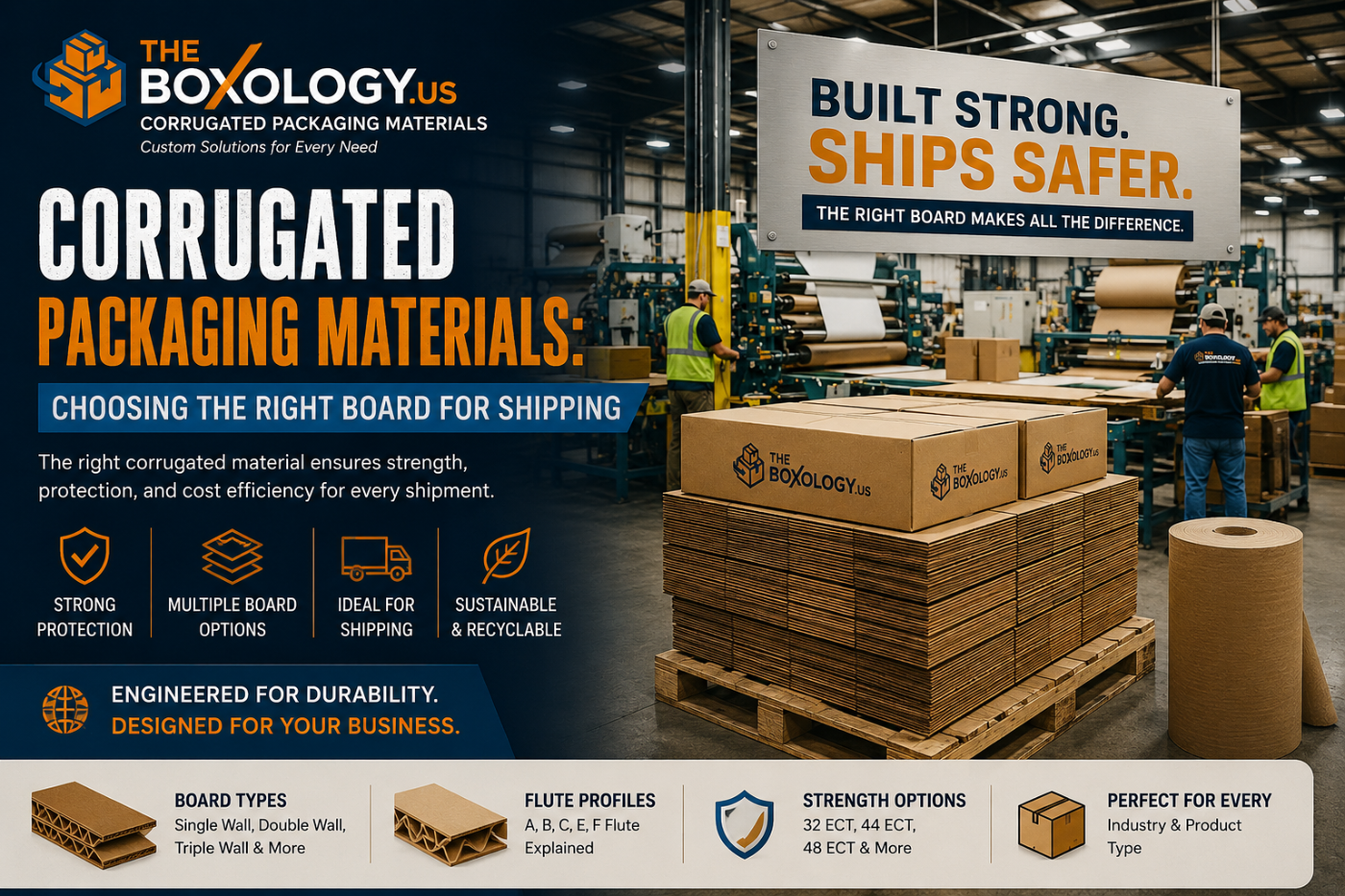







Selecting the right corrugated packaging materials is one of the most important decisions a business can make when designing shipping boxes. The material you choose directly affects product protection, shipping costs, warehouse efficiency, sustainability, and customer satisfaction. A well-designed package should withstand compression, vibration, impacts, and stacking throughout the supply chain while maintaining a professional appearance when it reaches the customer.
Over the past decade, I’ve worked with manufacturers, ecommerce brands, and distributors that initially focused only on box dimensions or printing. In reality, the performance of a shipping box depends far more on the board construction, flute profile, liner quality, and compression strength than on its exterior graphics. Choosing the wrong board can lead to crushed packages, product damage, higher return rates, and unnecessary shipping expenses.
Modern corrugated packaging is engineered to balance strength with efficiency. Whether you’re shipping cosmetics, electronics, subscription boxes, food products, industrial components, or luxury retail packaging, selecting the correct board material ensures products remain protected without increasing packaging costs.
In this guide, you’ll learn how corrugated packaging materials are manufactured, how different board constructions compare, when to choose each flute profile, and how to select the best material for your specific shipping requirements.
Quick Answer
What are corrugated packaging materials?
Corrugated packaging materials are engineered paper-based boards made from one or more fluted paper mediums bonded between flat linerboards. Different board constructions, flute profiles, and liner materials provide varying levels of strength, cushioning, print quality, and durability. Selecting the right corrugated board depends on product weight, shipping conditions, stacking requirements, and packaging budget.
Key Takeaways
- Corrugated packaging materials provide strength without excessive weight.
- Different flute profiles offer different levels of cushioning and compression resistance.
- Board construction affects durability, print quality, and shipping performance.
- Selecting the proper material reduces damage, returns, and shipping costs.
- Packaging material should always match the product’s weight and transportation method.
In This Guide
You’ll learn:
- Why corrugated packaging materials matter
- How corrugated board is manufactured
- Corrugated board construction explained
- Common corrugated board types
- Flute profile comparison
- Choosing materials for different industries
- Understanding board strength ratings
- Common packaging material mistakes
- How to select the right corrugated board
Why Corrugated Packaging Materials Matter
Many businesses assume every corrugated box performs the same, but that’s rarely true. Two boxes with identical dimensions can perform very differently depending on the board material used.
The right corrugated material protects products from impacts, stacking pressure, moisture, and vibration throughout transportation. It also influences production costs, shipping efficiency, warehouse storage, and customer experience.
For ecommerce businesses, stronger packaging means fewer damaged deliveries and lower return rates. For manufacturers shipping heavy products, selecting the correct board prevents structural failure during pallet stacking and long-distance freight transportation.
Choosing an appropriate board isn’t simply about durability—it’s about balancing protection, weight, sustainability, print quality, and cost. (EPA)
What Are Corrugated Packaging Materials?
Corrugated packaging materials consist of multiple layers of paper engineered to maximize strength while minimizing weight.
Unlike ordinary cardboard, corrugated board includes a fluted paper medium positioned between flat linerboards. These flutes create small air columns that absorb shock, improve compression strength, and increase structural rigidity without adding excessive weight.
Depending on the intended application, manufacturers produce corrugated packaging using different linerboard materials, flute sizes, adhesives, and board constructions.
Today’s corrugated packaging materials are widely used for:
- Ecommerce shipping boxes
- Subscription packaging
- Retail packaging
- Electronics packaging
- Cosmetic packaging
- Industrial shipping containers
- Food packaging
- Export packaging
Because corrugated board is lightweight, recyclable, and highly customizable, it has become the global standard for protective shipping packaging. Businesses looking for durable shipping solutions often invest in custom corrugated boxes designed specifically for their product dimensions and transportation requirements.
Understanding Corrugated Board Construction
Every corrugated sheet is built using three primary components that work together to provide strength, cushioning, and durability.
Understanding how these layers function makes it much easier to choose the right packaging material for your products.
Outer Liner
The outer liner is the visible exterior surface of a corrugated box.
This layer protects the internal structure while providing the primary printing surface for branding, graphics, product information, and finishing techniques.
Manufacturers commonly use:
- Virgin Kraft linerboard
- White top linerboard
- Recycled linerboard
Virgin kraft liners generally provide the highest tear resistance and durability, while white linerboards offer superior print quality for retail packaging.
Fluted Medium
The fluted medium is the heart of corrugated packaging.
Manufactured by passing paper through heated corrugating rollers, the medium forms a series of arches that create air pockets between the liners.
These flutes perform several important functions:
- Absorb impact during transportation
- Improve compression strength
- Increase stacking performance
- Reduce vibration damage
- Add rigidity without excessive weight
The flute profile selected has a significant effect on cushioning, print quality, and overall box performance.
Inner Liner
The inner liner forms the interior surface of the box and supports the fluted medium.
Although customers rarely notice it, the inner liner contributes significantly to compression strength and structural integrity.
Depending on the application, manufacturers may select different liner grades to improve moisture resistance, puncture resistance, or sustainability.
When all three layers work together, they create a lightweight yet highly durable packaging material capable of protecting products throughout the shipping process.
Common Types of Corrugated Board
Not every corrugated board is built for the same purpose. Manufacturers produce different board constructions depending on the product’s weight, shipping conditions, stacking requirements, and handling environment.
Understanding these board types helps businesses avoid overpaying for unnecessary strength or underestimating the protection their products require.
Single Face Board
Single face corrugated board consists of one flat liner attached to a single fluted medium.
Instead of being used as a finished shipping box, it is primarily used as protective wrapping for fragile products, furniture, glass, and industrial equipment.
Best Applications
- Product wrapping
- Furniture protection
- Glass packaging
- Surface protection
- Industrial cushioning
Advantages
- Lightweight
- Flexible
- Cost-effective
- Excellent cushioning
Single Wall Board
Single wall corrugated board is the most widely used packaging material worldwide.
It contains two linerboards separated by one fluted medium, creating an excellent balance between strength, printability, and cost.
Most ecommerce packaging, subscription boxes, retail packaging, and mailer boxes use single wall construction.
Best Applications
- Ecommerce packaging
- Cosmetic packaging
- Electronics
- Subscription boxes
- Retail shipping
Advantages
- Excellent strength-to-weight ratio
- Affordable
- Easy to print
- Lightweight
- Recyclable
Single-wall construction is also widely used for custom mailer boxes because it offers an ideal balance between protection, presentation, and shipping efficiency.
Double Wall Board
Double wall corrugated board contains three linerboards separated by two fluted mediums.
The additional layer significantly improves stacking strength and puncture resistance, making it suitable for heavier products and long-distance shipping.
Best Applications
- Industrial equipment
- Automotive parts
- Heavy electronics
- Export packaging
- Warehouse storage
Advantages
- Higher compression strength
- Better puncture resistance
- Superior stacking performance
- Improved durability
Triple Wall Board
Triple wall board is one of the strongest corrugated packaging materials available.
With four linerboards and three fluted mediums, it is often used as an alternative to wooden crates for transporting extremely heavy or high-value products.
Best Applications
- Industrial machinery
- Military equipment
- Export shipments
- Heavy manufacturing
- Large mechanical components
Advantages
- Exceptional durability
- Maximum compression strength
- Outstanding impact protection
- Ideal for heavy-duty logistics
Corrugated Flute Profiles Explained
The flute profile plays a critical role in determining the performance of corrugated packaging.
Flutes influence:
- Compression strength
- Cushioning
- Print quality
- Material thickness
- Shipping performance
Selecting the appropriate flute profile depends on the product being shipped and the desired balance between protection and presentation.
A Flute
A Flute has the largest flute height among standard profiles.
Its deep arches provide outstanding cushioning and vertical compression strength, making it suitable for fragile products.
Best For
- Glassware
- Ceramics
- Industrial products
- Heavy shipping
B Flute
B Flute offers smaller flutes with excellent puncture resistance.
It creates a flatter surface that improves print quality while maintaining good structural performance.
Best For
- Food packaging
- Canned products
- Retail cartons
- Die-cut packaging
C Flute
C Flute is considered the industry’s most versatile flute profile.
It provides an excellent combination of cushioning, stacking strength, and printability.
Because of its balanced performance, C Flute remains one of the most commonly used flute profiles in ecommerce shipping.
Best For
- Shipping boxes
- Ecommerce packaging
- Consumer goods
- Electronics
E Flute
E Flute features thinner flutes that create a smooth printing surface.
Its slim profile makes it particularly popular for luxury retail packaging where premium graphics and structural appearance are equally important.
Best For
- Cosmetic packaging
- Jewelry packaging
- Luxury retail boxes
- Mailer boxes
- Gift packaging
F Flute
F Flute is an ultra-thin corrugated profile designed for premium retail packaging.
Although thinner than E Flute, it still provides impressive rigidity while allowing extremely high-quality printing.
Best For
- Luxury cosmetics
- Premium electronics
- Small retail packaging
- High-end presentation boxes
Corrugated Flute Comparison
| Flute Type | Thickness | Cushioning | Print Quality | Best Applications |
| A Flute | High | Excellent | Moderate | Fragile products |
| B Flute | Medium | Good | Very Good | Retail packaging |
| C Flute | Medium-High | Excellent | Good | Shipping boxes |
| E Flute | Thin | Moderate | Excellent | Luxury packaging |
| F Flute | Ultra Thin | Moderate | Outstanding | Premium retail boxes |
Which Corrugated Material Is Best for Different Products?
Choosing the right corrugated material depends on product weight, fragility, shipping distance, and presentation requirements.
Cosmetic Products
Recommended Board
- Single Wall
- E Flute
Why?
These materials provide excellent print quality while maintaining enough strength to protect lightweight cosmetic products during shipping.
Electronics
Recommended Board
- Single Wall
- C Flute
For heavier electronics, Double Wall construction may provide additional protection against impacts during transportation.
Food & Beverage
Recommended Board
- B Flute
- Kraft Linerboard
These materials offer strong puncture resistance while supporting efficient storage and transportation.
Jewelry
Recommended Board
- E Flute
- Premium White Linerboard
The smoother surface supports luxury printing techniques such as foil stamping, embossing, and soft-touch lamination.
Industrial Products
Recommended Board
- Double Wall
- Triple Wall
Heavy industrial products require superior compression strength, puncture resistance, and long-term structural stability.
Packaging Expert Recommendation
One of the biggest misconceptions in packaging is that thicker board automatically means better packaging.
In reality, selecting a board that’s stronger than necessary often increases production costs, shipping weight, and freight charges without providing meaningful additional protection.
The best packaging solutions are engineered around the product itself. Factors such as weight, fragility, shipping distance, storage conditions, and customer expectations should guide your board selection.
For most ecommerce brands, C Flute and E Flute provide the ideal balance between structural performance, print quality, and cost efficiency. Businesses shipping heavier products, however, should consider Double Wall construction to improve stacking strength and reduce the risk of shipping damage.
Choosing the Right Board Strength
Selecting the correct corrugated board isn’t only about flute size. The board’s compression strength is equally important because it determines how well a shipping box performs under stacking pressure and during transportation.
Two common measurements are Edge Crush Test (ECT) and Burst Strength. Most ecommerce businesses rely on ECT because it better reflects real-world shipping conditions where boxes are stacked in warehouses and delivery vehicles.
For a deeper explanation of compression ratings and performance, read our guide on corrugated box board grades before selecting your board strength.
32 ECT
32 ECT is the industry standard for most ecommerce shipments.
It provides sufficient compression strength for lightweight and medium-weight products while keeping packaging costs under control.
Best For
- Apparel
- Cosmetics
- Subscription boxes
- Consumer goods
- Mailer boxes
44 ECT
44 ECT offers higher stacking strength and is recommended for heavier shipments or products that travel long distances.
Best For
- Electronics
- Kitchenware
- Automotive parts
- Bulk retail orders
48 ECT
48 ECT is designed for demanding shipping environments where boxes experience significant stacking loads or contain heavy products. (FBA)
Best For
- Industrial equipment
- Machinery parts
- Export packaging
- Heavy commercial shipments
Common Corrugated Packaging Materials
Different liner materials influence durability, appearance, sustainability, and print quality.
Virgin Kraft Linerboard
Manufactured from virgin wood fibers, kraft linerboard provides excellent tear resistance and structural strength.
Ideal for heavy-duty shipping applications.
White Top Linerboard
White linerboard creates a smooth printing surface capable of producing vibrant graphics.
It is commonly used for premium retail packaging and branded ecommerce boxes.
Recycled Corrugated Board
Made from recovered paper fibers, recycled corrugated board reduces environmental impact while maintaining reliable shipping performance.
It has become increasingly popular among environmentally conscious brands.
Moisture-Resistant Board
Products exposed to humid environments or cold-chain logistics often require moisture-resistant coatings that improve durability during transportation.
If you’re comparing different materials used in ecommerce packaging, our article on mailer box materials provides a detailed breakdown of the available options.
How to Choose the Right Corrugated Packaging Material
Selecting the right board starts with understanding your product rather than choosing the strongest material available.
Consider these factors before placing a production order.
Product Weight
Heavier products require stronger board construction and higher compression strength.
Choosing the correct mailer box size is just as important as selecting the right board because both influence shipping costs and product protection.
Product Fragility
Fragile products benefit from flute profiles that provide greater cushioning and shock absorption.
Shipping Distance
Long-distance transportation typically exposes packaging to additional stacking pressure, vibration, and handling.
Storage Conditions
Warehouse stacking height and storage duration influence the required board strength.
Branding Requirements
Luxury packaging often prioritizes smoother linerboards that support premium printing, embossing, foil stamping, and specialty finishes.
Common Mistakes When Choosing Corrugated Packaging Materials
Many businesses focus only on dimensions while overlooking the engineering behind corrugated board.
Avoid these common mistakes.
Choosing the Cheapest Material
Lower material costs often result in higher replacement, return, and damage expenses.
Ignoring Shipping Conditions
Boxes shipped internationally require stronger construction than products delivered locally.
Selecting Oversized Packaging
Oversized boxes increase dimensional weight charges while allowing products to shift during transportation.
If you’re unsure whether a mailer or traditional carton is the better option, compare cardboard mailer boxes vs shipping boxes before finalizing your packaging design.
Using More Strength Than Necessary
Buying triple wall board for lightweight products increases costs without improving shipping performance.
Choosing the correct board is always more economical than choosing the strongest board.
Final Thoughts
Corrugated packaging materials form the foundation of reliable shipping packaging. The right combination of board construction, flute profile, linerboard, and compression strength protects products while reducing shipping costs and improving customer satisfaction.
Learn how custom corrugated shipping boxes improve product safety while supporting efficient warehouse and ecommerce operations.
Instead of selecting packaging based solely on price, businesses should evaluate product weight, shipping distance, storage conditions, branding requirements, and sustainability goals.
Selecting high-quality shipping boxes helps reduce product damage while improving the overall customer delivery experience.
Well-engineered corrugated packaging doesn’t simply survive transportation—it improves operational efficiency, strengthens brand perception, and creates a better customer experience from warehouse to doorstep.
Need Custom Corrugated Packaging for Your Products?
Choosing the right corrugated packaging material requires more than selecting a box size. Board construction, flute profile, liner quality, and compression strength all influence how well your packaging performs throughout the supply chain. (ASTM)
Investing in custom packaging ensures every box is engineered to match your product, branding, and logistics requirements.
At The Boxology.US, we manufacture custom corrugated packaging tailored to your products, shipping requirements, and branding goals. Whether you need durable ecommerce mailer boxes, retail packaging, or heavy-duty shipping cartons, our team can recommend the ideal board construction for maximum protection and cost efficiency.


