Skip to content









In the custom packaging industry, the term “premium” is often used to describe how a box looks on a retail shelf. However, for a business owner responsible for shipping thousands of units across the United States, beauty is secondary to structural survival. When you evaluate sliding boxes against traditional rigid setups, you aren’t just choosing a style; you are choosing a mechanical solution to a logistical problem.
In my experience working with bulk manufacturers and shipping logistics, I have seen brands lose significant revenue because they prioritized the “snap” of a magnetic lid over the lateral security of a sliding box. Both formats have their place, but when the goal is preventing internal shifting and external crushing, the physics of a sliding box packaging setup is hard to beat.
The Structural Mechanics of a Sliding Box

What exactly makes a sliding box different? At its core, it is a two-piece assembly consisting of an outer sleeve and an inner tray. This is often referred to as a sliding drawer box or a pull out box. Unlike a standard telescope box where the lid relies on friction or a vacuum seal to stay closed, the slider box utilizes a horizontal track.
This design inherently creates a double-walled structure on the two sides where the tray and sleeve overlap. In terms of “Box Compression Test” (BCT) scores, this overlap is a quiet hero. When a pallet is stacked four or five layers high in a warehouse, that extra layer of chipboard or corrugated material in a slide box packaging configuration prevents the walls from buckling under vertical pressure. Many businesses looking for this level of durability often start their journey by exploring sliding boxes to see how the sleeve mechanism integrates with their product dimensions.
Why Standard Rigid Boxes Sometimes Fail
Standard rigid boxes are excellent for display, but they have a fatal flaw in high-speed shipping environments: vertical lift. If a package is dropped, the air pressure inside can actually force the lid open. A slider boxes design, however, requires a deliberate horizontal pull to open. Without that specific motion, the product remains encased in a 360-degree protective sleeve. This makes the slide in box a much safer bet for heavy items or products with a high center of gravity.
While custom rigid boxes offer undeniable elegance and are a staple for luxury branding, the physical “lock” of a sliding box provides that extra peace of mind during rough transit.
A Comparative Look: Security, Cost, and Utility
| Feature | Standard Rigid Box | Sliding Boxes (Drawer Style) |
| Primary Closure | Friction or Magnets | Mechanical Sleeve (Track) |
| Crush Resistance | Moderate | High (Double-walled sides) |
| Accidental Opening | Possible if dropped | Nearly impossible |
| Material Usage | Moderate | Higher (Requires Sleeve) |
| Best For | Luxury Apparel, Stationery | Tech, Glassware, Heavy Goods |

The Boxology’s Expert Insight: The “Friction Variance”
The Boxology’s Expert Insight: What most businesses overlook when ordering custom drawer box packaging is the “friction variance” caused by humidity. If your warehouse is in a humid climate like Florida, the fibers in the paperboard will expand slightly. A sliding box that fits perfectly in a dry factory may become difficult to open in a humid retail shop. At The Boxology.US, we recommend a “tolerance gap” of 0.5mm to 1mm to ensure the box sliding motion remains smooth regardless of the weather. This small adjustment prevents customers from tearing the pull out box just to get to their purchase.
Engineering the Perfect Slide Open Boxes
When we talk about box slide mechanics, we are looking at how the tray interacts with the sleeve. For lightweight retail items, a simple paperboard slider box is sufficient. However, for B2B shipments, you need to consider the “Grammage” of the material. What most brands miss is that the sleeve needs to be slightly more rigid than the tray to maintain the integrity of the slide open boxes over multiple uses.
In my experience, using sliding boxes for electronics requires a specific internal tension. If the sliding box packaging is too loose, the internal components might rattle, leading to micro-scratches on the product surface. Conversely, a custom drawer box packaging that is too tight can frustrate the end-user.
- 1200gsm Chipboard: This is the industry standard for a sliding drawer box that needs to feel heavy and substantial.
- Corrugated Inserts: If you are using sliding box packaging for fragile items, the internal tray should be lined with custom-cut foam to prevent “internal rattling.”
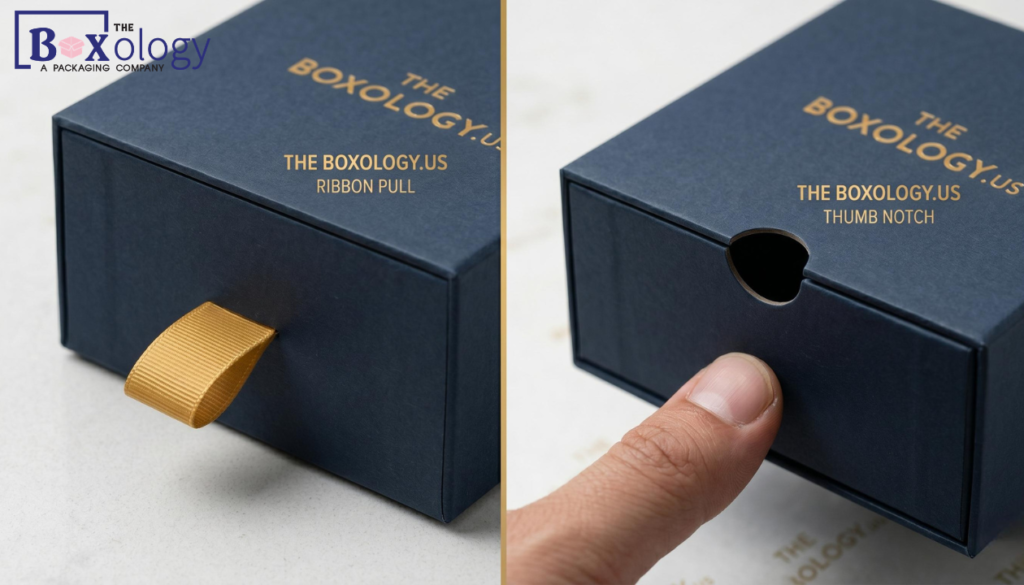
- The Pull Mechanism: A slide box packaging unit can be opened via a ribbon pull, a thumb notch, or a simple finger hole.
Security Beyond the Warehouse
Security isn’t just about preventing breaks; it’s about preventing tampering. A sliding box is notoriously difficult to reseal perfectly once the original manufacturer’s shrink wrap or sticker is broken. This provides an added layer of confidence for retailers. When a customer sees a sliding box packaging unit on the shelf, the integrity of the slide open boxes tells them the product hasn’t been handled.
Many of our clients at The Boxology.US have found that transitioning to a custom drawer box packaging reduced their “Return to Vendor” (RTV) rates by nearly 15%. This isn’t because the sliding boxes were “stronger” in a lab it’s because the slider boxes prevented the product from sliding around inside the package.
Is a Sliding Box Right for Your Business?
While the benefits of a sliding box are clear, there are practical considerations. A sliding box typically requires more material than a standard box because the sleeve must wrap entirely around the tray. This can lead to a slightly higher price point per unit. However, you must weigh this against the cost of damaged goods.
If you are shipping items like:
- High-end skincare jars (Glass)
- Artisan candles
- Subscription tech kits
- Limited edition footwear
…then the sliding box is the practical choice. The box slide experience adds a level of theater to the unboxing that justifies the investment in sliding box packaging.
Checklist for Ordering Your First Slider Box
- Check the Tolerance: Ask for a sample to test the sliding box opening speed.
- Material Weight: Ensure the outer sleeve is sturdy enough to prevent the box slide from sticking.
- Internal Fit: Does the sliding drawer box leave too much room for movement?
- Finish: Consider a “Scuff-Proof” lamination so the box sliding doesn’t leave marks.
Final Thoughts on Product Integrity
Choosing between these two formats comes down to the journey your product takes. If your items are sold over a counter, a standard rigid box is fine. But if your products are traveling through the USPS or FedEx systems, the lateral reinforcement of sliding boxes is a reliable insurance policy.
At The Boxology.US, we don’t just provide containers; we provide structural solutions. We understand that a slider box isn’t just a container it’s the first physical touchpoint your customer has with your brand. Whether you need a robust slide in box for heavy retail items or elegant slide open boxes for jewelry, the focus must remain on the balance between style and security.
If you are unsure whether a slide open boxes design or a traditional setup is best for your current inventory, we are here to help. We offer a Free Consultation to review your product dimensions and shipping methods to find the most cost-effective and sturdy solution.

Advice for New Partners: For a limited time, we are offering 25% off your first order of any custom drawer box packaging to help you make the transition to better security without the initial overhead stress. Let’s build something that stays together, no matter how rough the road is.